Contracted nose appearing long after rhinoplasty: how is it approached?

A contracted nose that appears some time after rhinoplasty often reflects two factors acting together: contraction of the capsule surrounding the implant, and scar-related change in the skin and soft tissue. The approach is to first remove the causative implant and the contracted capsule to release the contracting force, then restore the shortened length of the nose, and finally build a support structure. When both support and stability are needed, autologous rib cartilage can be an option — and which material and technique are used depends on the examination findings (results vary by individual).
Why and when does a contracted nose develop?
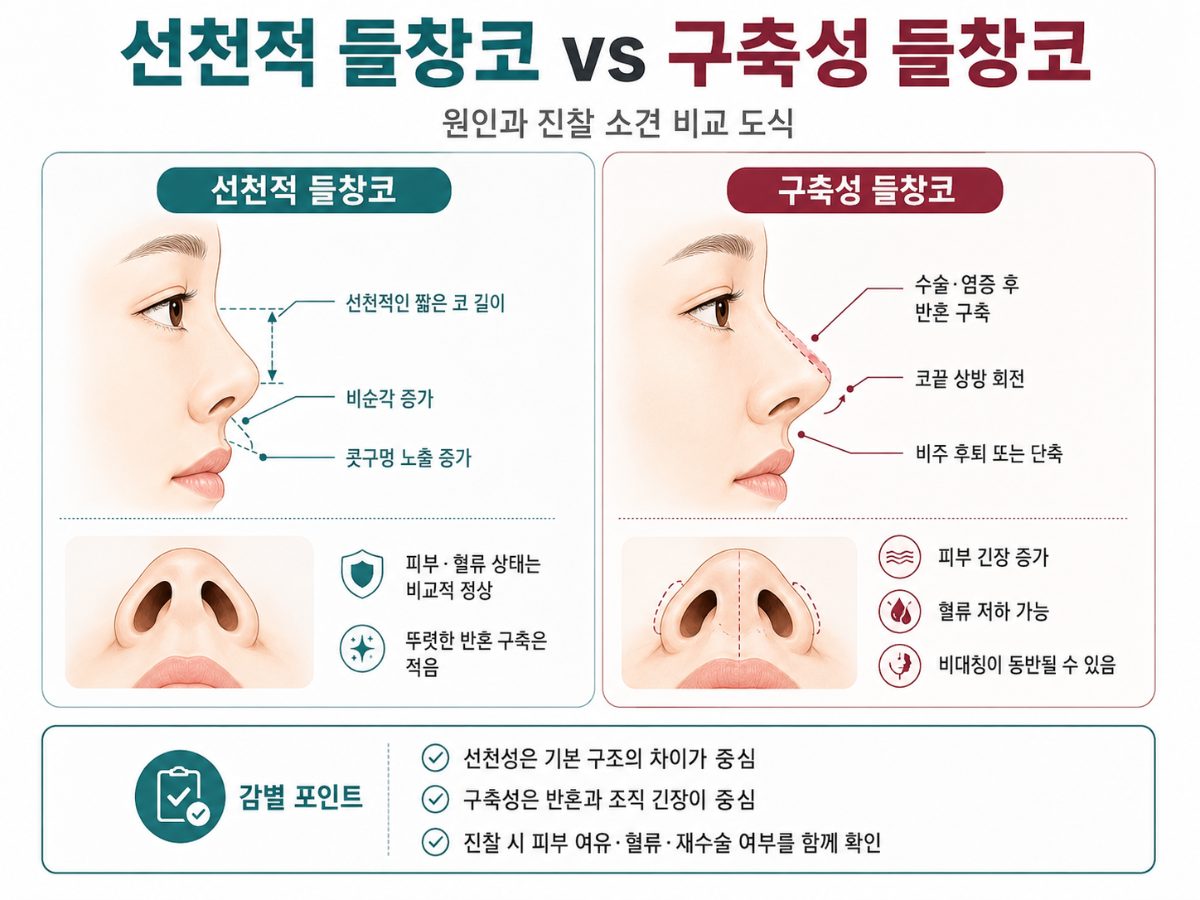
Contracture progresses as capsule contraction, chronic inflammation, and scar-related change overlap, so the nose shortens upward and the tip lifts. It most often appears within a few months to two years after surgery, but rarely it can progress slowly even after a longer period. Time alone does not confirm contracture; associated findings such as a lifted tip, skin hardening, and a shortened nose are assessed together.
What do we examine to judge contracture?
The approach is not set by textbook definitions alone; it depends on examination findings. In practice we check the following together.
- What we check on exam: the angle of tip lift, skin thickness and hardening, whether the previous implant is palpable, inflammatory signs such as tenderness or redness, nostril symmetry, and nasal obstruction.
- Differential criteria: we separate simple tip lift from true contracture, and distinguish inflammatory contraction from scar contraction. When inflammatory signs are clear, controlling inflammation comes first; when scar contraction predominates, releasing the contracted tissue is central.
- When diagnostic tools are needed: if chronic inflammation or obstruction is suspected, we may check the inner mucosa with nasal endoscopy and, when needed, the area around the implant with CT before deciding on the technique.
How was this case approached?
The following is not meant to emphasize a particular result, but to show the reasoning used to make decisions when similar findings are present.
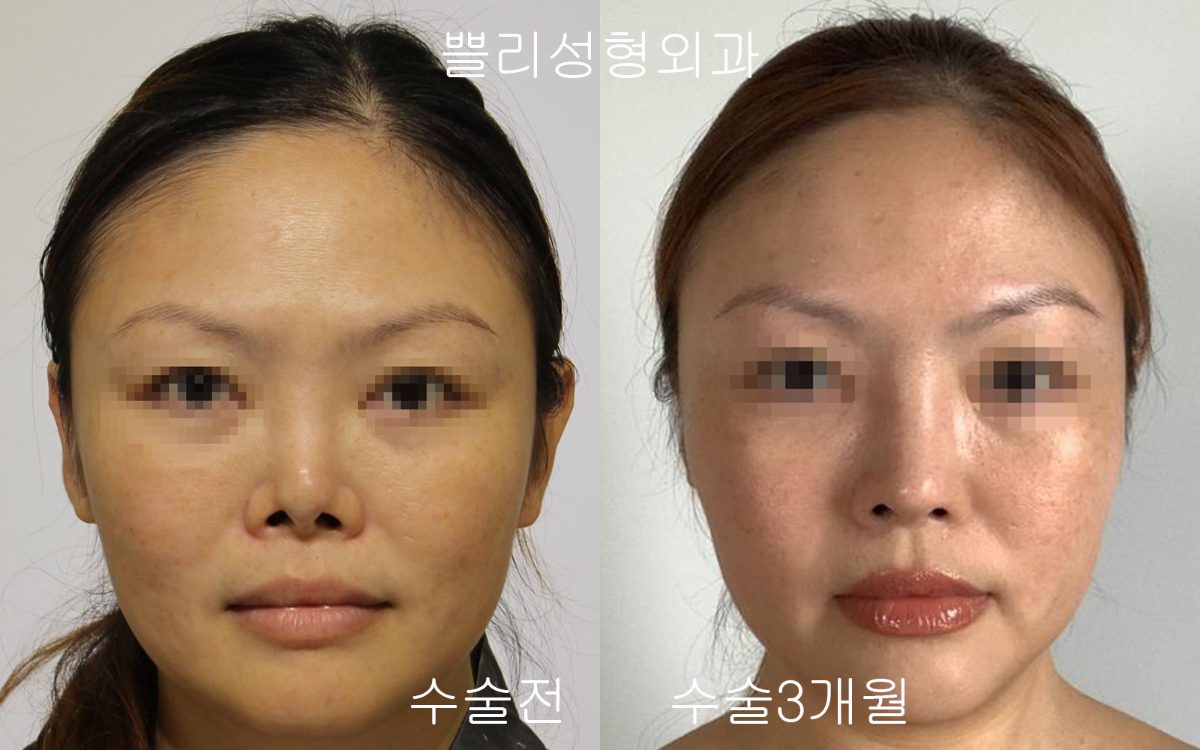
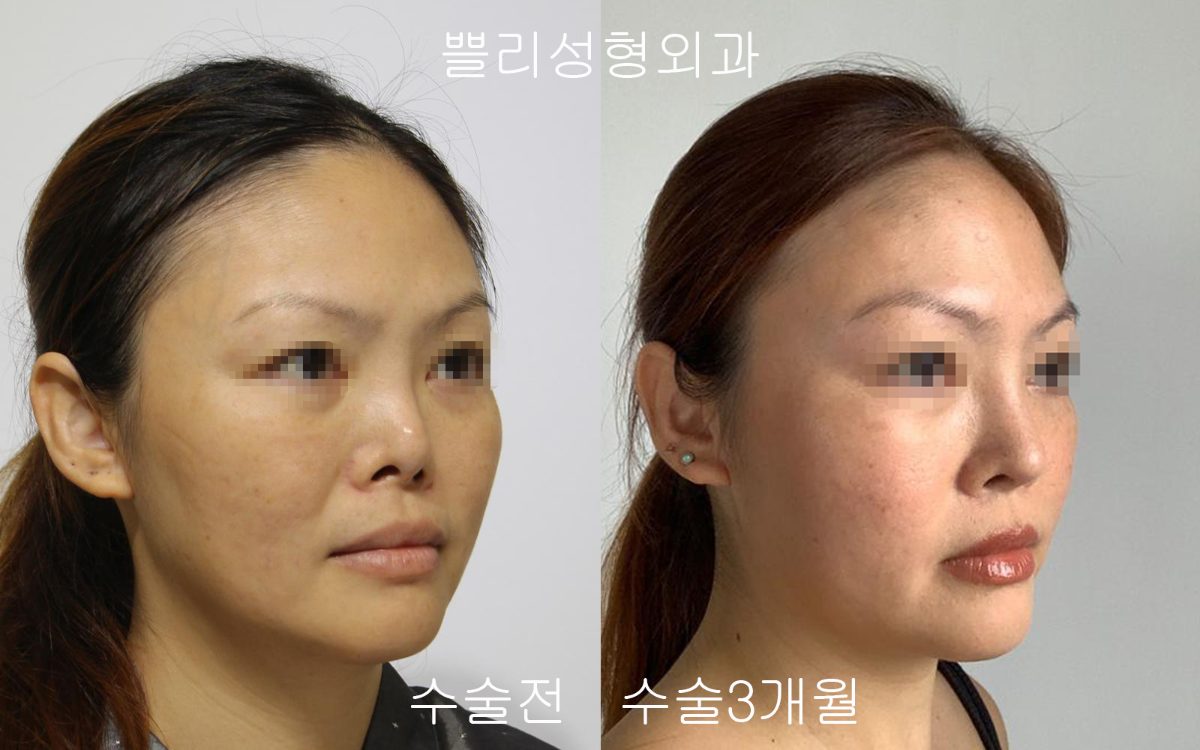
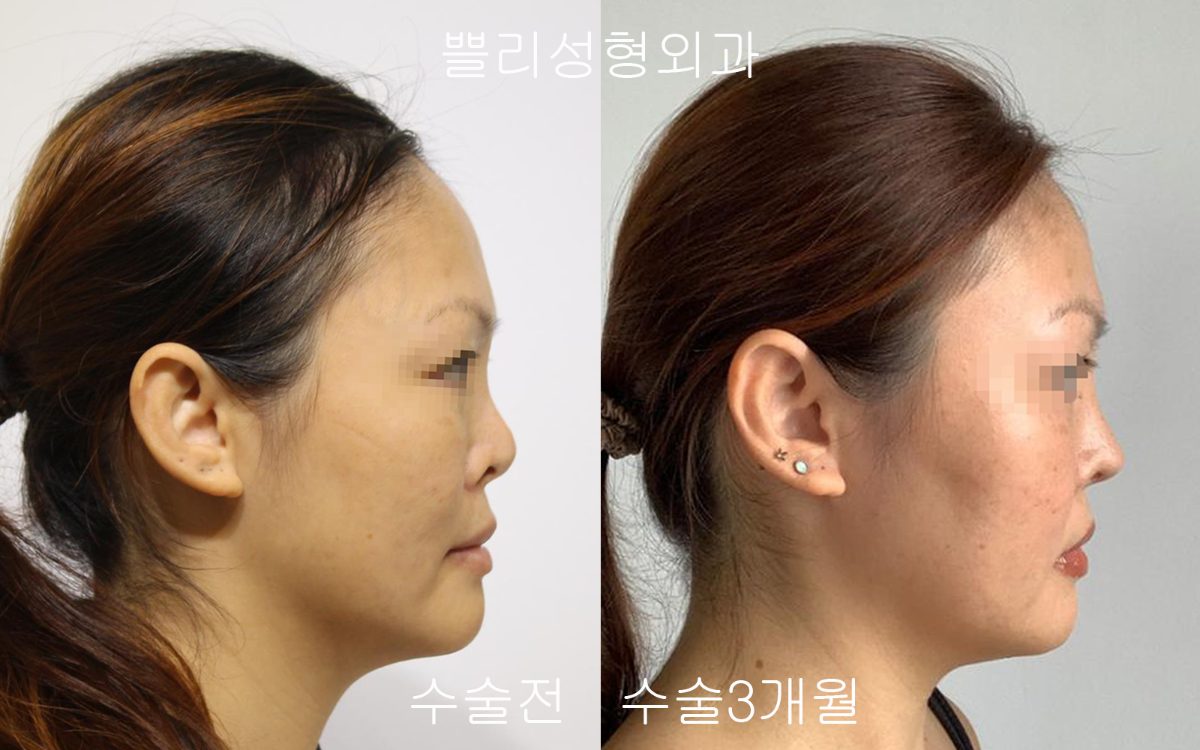
After rhinoplasty using a previous implant, contracture had progressed gradually. On examination there was tip lift, thinned and hardened skin, and a palpable previous implant. Judging that scar contraction predominated over clear acute inflammation, the approach proceeded in the following order.
First, the cause of contraction is removed. The previous implant and the surrounding capsule that drives contraction are removed together to release the force pulling on the nose. Second, in the space gained by removing the capsule, the shortened length of the nose is restored. Third, considering the thinned skin and the risk of re-contracture, autologous rib cartilage is used to build tip support and a lengthening structure and to shape the form.
Autologous rib cartilage was considered because, in a re-contracture setting with thin skin and reduced blood supply, placing the same type of implant again may carry a burden of visibility or re-contracture. In addition, the remaining septal cartilage may be insufficient after prior surgery, so when both support and length are needed, rib cartilage becomes an option. This, however, is the judgment for these findings; when skin and support are favorable, another material may be suitable.
What is the purpose of each step?
Remove the cause - Release the contracting force - Remove the previous implant + contracted capsule
Restore length - Recover the shortened nose - Lengthen within the space that was gained
Support and shaping - Ease re-contracture burden, form the shape - Build tip support and extension with autologous rib cartilage
What about recovery and limitations?
About 70–80% of swelling usually subsides within 2–3 weeks, while subtle residual swelling settles over 3–6 months (varies by individual). Autologous rib cartilage may involve donor-site pain, subtle warping over time, and some possibility of partial resorption or deformation, so regular follow-up is needed. Revision for contracture is a process of reducing the cause of contraction, but the possibility of re-contracture cannot be entirely excluded, and its degree varies by individual.
Summary
A late-appearing contracture is approached within the broad framework of removing the cause → restoring length → support and shaping, with the material and technique depending on examination findings. Autologous rib cartilage is an option when support and stability need to be considered together in a setting of thin skin and re-contracture risk. Because the suitable method differs with each nose, an in-person evaluation by a specialist is needed for an accurate decision.
Frequently Asked Questions (FAQ)
Q1. Can contracture develop long after rhinoplasty?
It is uncommon but possible. Capsule contraction or chronic inflammation can progress late and appear gradually, so associated findings are assessed together with the passage of time.
Q2. Does removing only the implant release the contracture?
Removing the cause is an important start, but removing the contracted capsule, restoring length, and providing support are often needed together. The steps differ by condition.
Q3. Why consider autologous rib cartilage?
It is an option for obtaining support and stability together in a setting of thin skin and re-contracture risk. Depending on the situation, ear or septal cartilage may be suitable instead.
Q4. Can contracture recur after revision?
It cannot be entirely ruled out. That is why post-operative follow-up is needed, with early assessment if abnormal findings appear.
Related columns
- Why does a contracted nose occur? Causes and correction
- Rib cartilage in rhinoplasty: autologous vs. donor
- Ear cartilage vs. septal cartilage: how do they differ in rhinoplasty?
Sources
- General principles on contracture (contracted nose), capsule contraction, and autologous cartilage grafting from Korean Society of Plastic and Reconstructive Surgeons (KSPRS) academic materials and standard plastic surgery textbooks
- Textbook-level general knowledge on implant/capsule removal and autologous rib cartilage support in revision rhinoplasty
Author · Reviewer · Dates
- Author: Dr. Jihun Kim, Board-Certified Plastic Surgeon (VVLY Plastic Surgery Clinic)
- Published: 2026-08-18 · Last updated: 2026-08-18
Medical disclaimer
*This column is provided for general medical information and does not replace diagnosis or treatment for an individual patient. Indications for surgery or procedures, recovery, and possible side effects vary by individual; an in-person consultation and individual assessment by a specialist are needed for an accurate judgment.*