Ear cartilage vs. septal cartilage: how do they differ in rhinoplasty?

In rhinoplasty, ear (conchal) cartilage and septal cartilage differ in where they come from and how they behave, so their use depends on which part of the nose is being reinforced. Septal cartilage is straight and firm, which suits support structures such as a columellar strut that lifts the tip, or subtle dorsal reinforcement. Ear cartilage has a natural curve, so it is mainly used to wrap the tip or fill fine irregularities. Which cartilage is used, however, is decided after examining the remaining cartilage and the skin/support condition — and when one source is not enough, the two may be combined (results vary by individual).
How do the two cartilages differ anatomically?
Septal cartilage is harvested from the central partition of the nose (the septum) as a straight, flat plate. Because it is relatively firm, it can be shaped into load-bearing support structures. Ear cartilage is taken from the inner ear (conchal cartilage); it is thin, elastic, and naturally curved, which makes it well suited to wrapping areas that need a soft contour, such as the nasal tip.
Harvest conditions also differ. Septal cartilage is taken from inside the nose and leaves no external scar, but the available amount is limited — and if you have had previous nasal or septal surgery, less may remain. Ear cartilage can usually be harvested in a more generous amount, but it requires an incision behind or inside the ear.
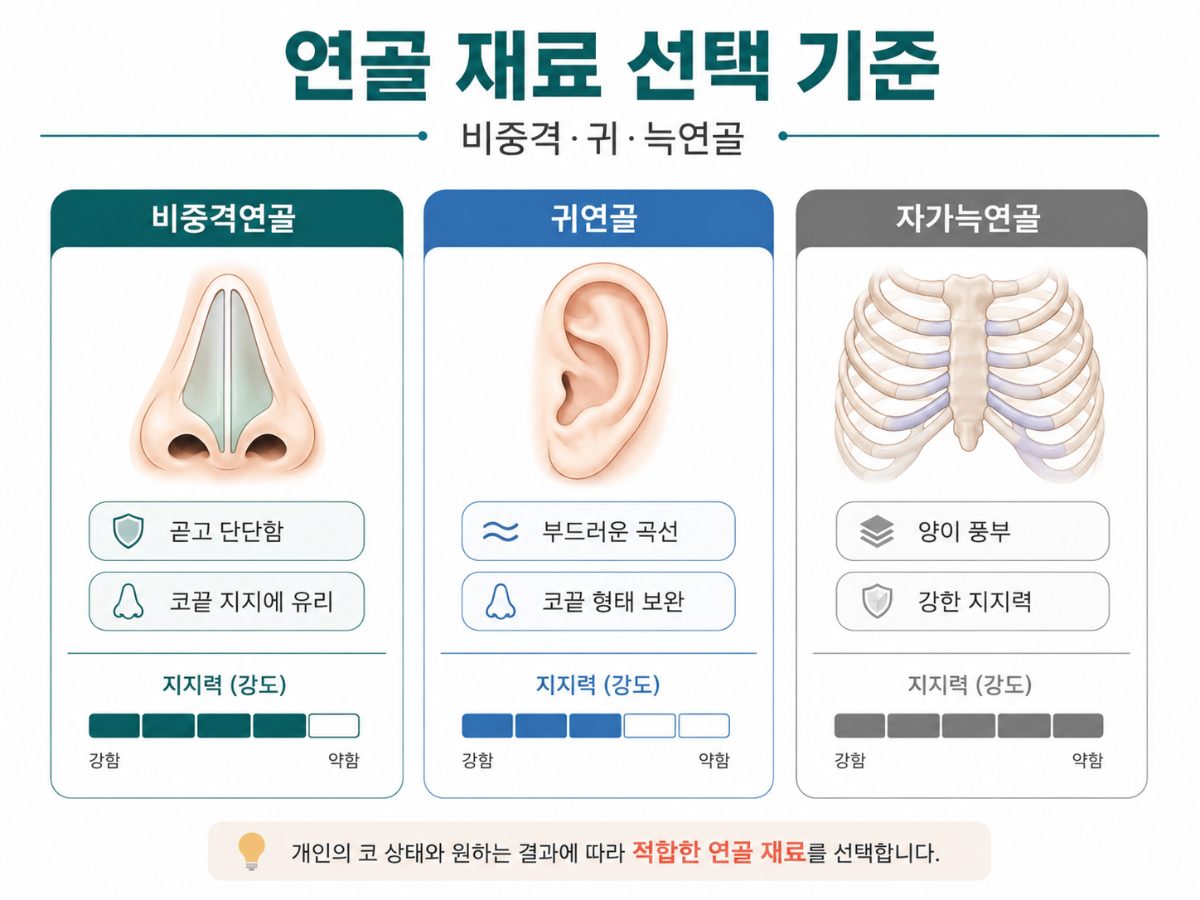
Where is each used in the nose?
The principle can be summarized as "firm material for support, curved material for wrapping." Septal cartilage is mainly used for structures that hold shape — a columellar strut, tip extension, and fine dorsal reinforcement. Ear cartilage suits soft finishing — a shield or cap graft over the tip, curved reinforcement, and cushioning under thin skin. The table below compares their properties and uses.
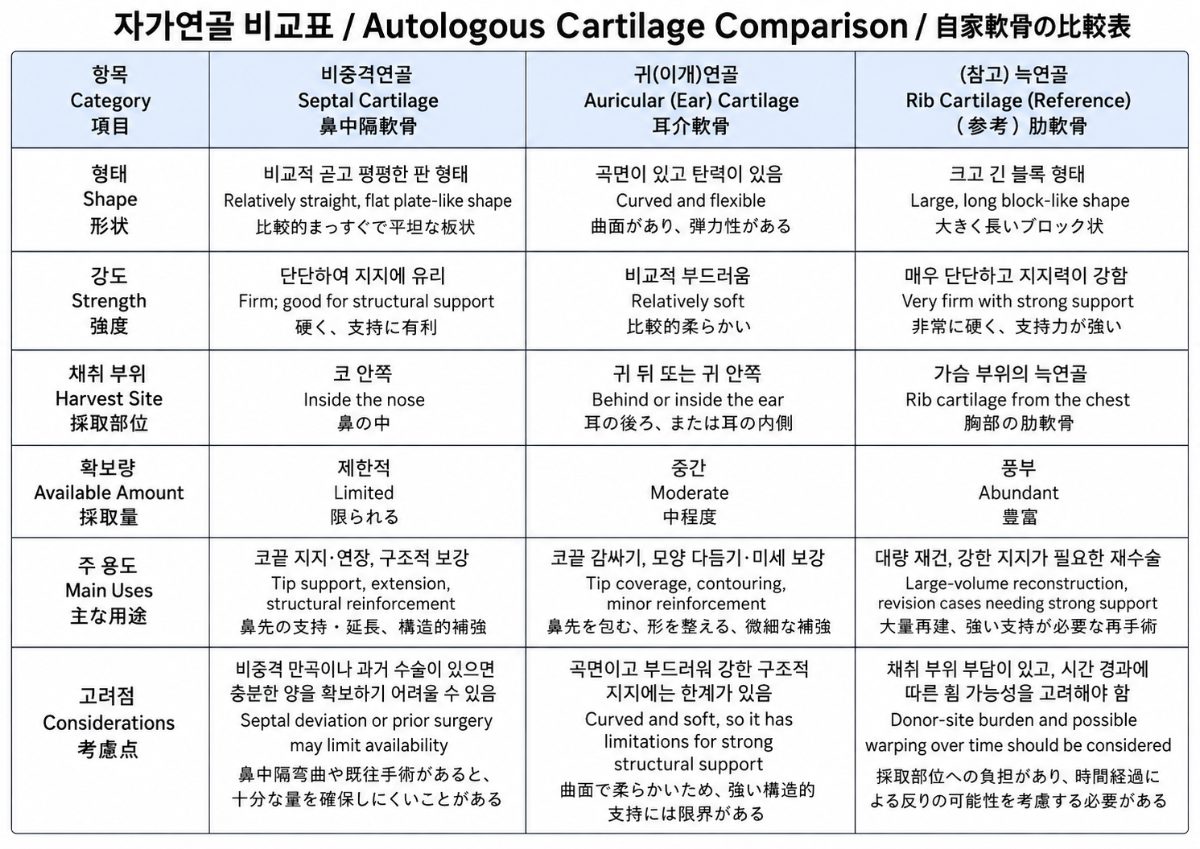
What guides the cartilage choice in actual practice?
The choice is not set by textbook use alone; it depends on examination findings. In our practice we check the following together.
- What we check on exam: tip support (recoil on pressure), skin thickness and blood supply, remaining septal cartilage (history of prior nasal/septal surgery), nasal obstruction, and the thickness and elasticity of the ear cartilage.
- When a material is chosen vs. avoided: when tip support is the priority, septal cartilage is considered first; but if the septum has been depleted by prior surgery or is markedly deviated, it is avoided as a support material and we move to ear or costal cartilage. When the skin is thin and there is a higher risk of graft edges showing, we consider wrapping the tip with ear cartilage for cushioning. When both support and volume are needed for large reconstruction or revision, costal cartilage is considered.
- When diagnostic tools are needed: if the remaining septal cartilage, its deviation, or the condition around an existing implant is unclear, we may check the inner mucosa with nasal endoscopy and, when needed, the septum and structure with CT before deciding on the technique.
What are the possible side effects and limitations?
Considerations differ by harvest site. If too much septal cartilage is taken, the basic support of the nose can weaken, so a defined framework (the L-strut) is preserved. Ear cartilage, because of its curve, may be limited as a stand-alone strong support, and rarely a change in ear shape or a hematoma can occur. Costal cartilage provides ample volume but may cause donor-site pain and can warp subtly over time. Any autologous cartilage carries some possibility of partial resorption or deformation, so regular follow-up is needed; the frequency and degree vary by individual.
Summary
As a broad framework, septal cartilage is for support, ear cartilage for curved reinforcement, and costal cartilage for large reconstruction. The actual choice, however, is determined by examining the remaining cartilage, skin, and support condition, with nasal endoscopy or CT when needed. When one source is insufficient, they may be combined. Because the suitable material differs with each nose, an in-person evaluation by a specialist is needed for an accurate decision.
Frequently Asked Questions (FAQ)
Q1. If septal cartilage is insufficient, must costal cartilage always be used?
No. Depending on how limited it is and how much support/volume is needed, ear cartilage may be enough in some cases and costal cartilage more suitable in others — this is judged on examination.
Q2. Does harvesting ear cartilage change the shape of the ear?
When an appropriate amount is taken from the inner conchal area, the external change is usually modest, but it varies by individual, so the harvest amount is adjusted.
Q3. Which cartilage is favorable for revision?
The septum may already have been used in the first surgery, so the remaining amount is the key issue. If it is insufficient, a switch to ear or costal cartilage is considered.
Q4. Does autologous cartilage resorb over time?
There is some possibility of partial resorption or deformation, which varies by material, site, and individual. That is why post-operative follow-up is needed.
Related columns
- Rib cartilage in rhinoplasty: how do autologous and donor rib cartilage differ?
- Five materials for dorsal augmentation: how do they compare (from silicone to diced rib cartilage)?
- When is preservation rhinoplasty appropriate?
Sources
- General principles on the properties and indications of cartilage grafts (septal, conchal, costal) from Korean Society of Plastic and Reconstructive Surgeons (KSPRS) academic materials and standard plastic surgery textbooks
- Textbook-level general knowledge on donor-site characteristics and complications of autologous cartilage grafts in rhinoplasty
Author · Reviewer · Dates
- Author: Dr. Jihun Kim, Board-Certified Plastic Surgeon (VVLY Plastic Surgery Clinic)
- Published: 2026-08-12 · Last updated: 2026-08-12
*This column is provided for general medical information and does not replace diagnosis or treatment for an individual patient. Indications for surgery or procedures, recovery, and possible side effects vary by individual; an in-person consultation and individual assessment by a specialist are needed for an accurate judgment.*