What Are the Advantages of Preservation Rhinoplasty? — No "Open Roof"

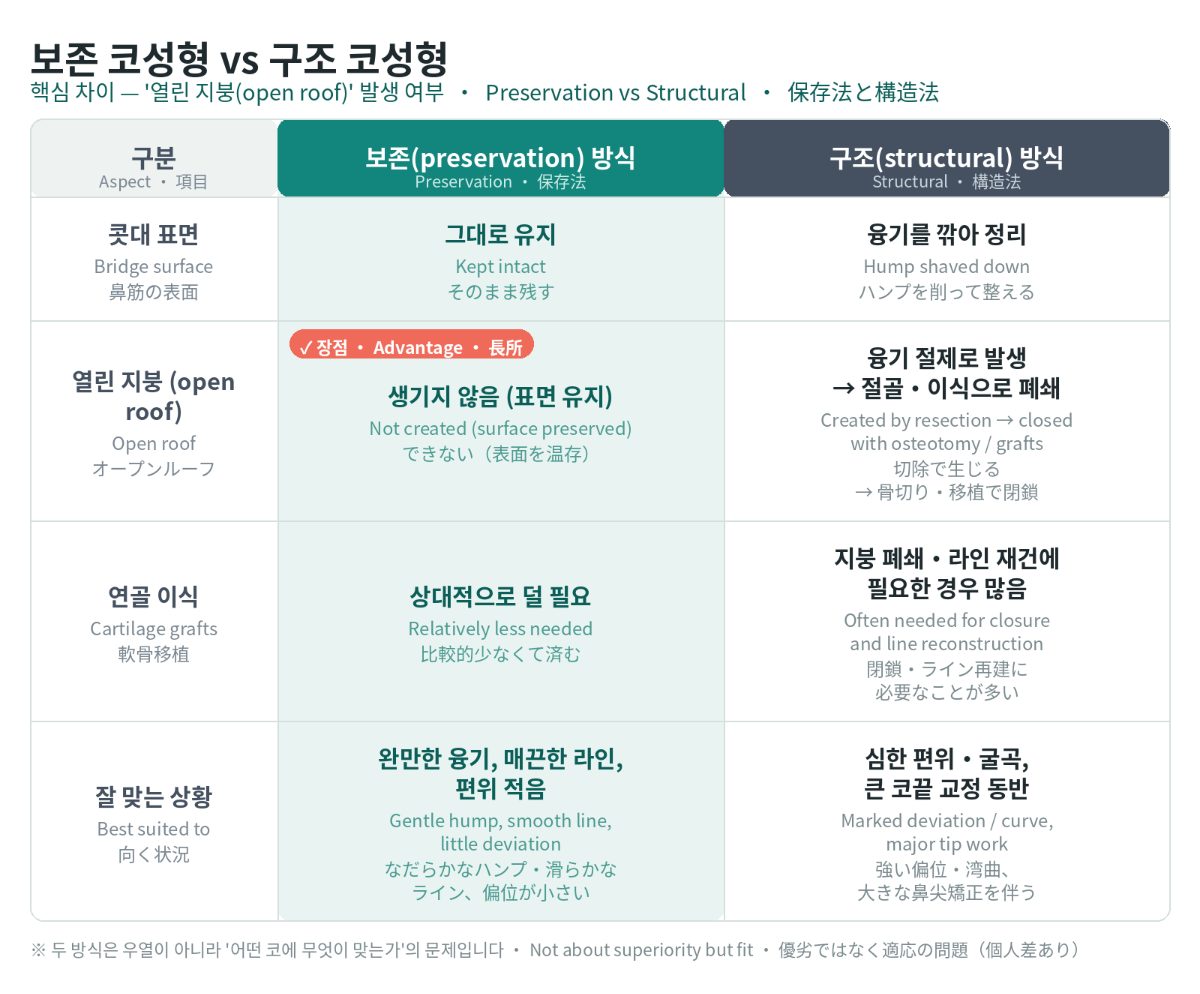
Preservation rhinoplasty lowers the height of the nose by removing bone and cartilage from beneath the bridge while leaving its natural roof (dorsum) intact. Unlike the structural method, which shaves the hump down, it does not touch the surface of the bridge — so a key advantage is that it does not create the "open roof" left behind when a hump is resected. As a result, there is less need to close that roof with cartilage grafts and line reconstruction, which favors preserving the original smooth curve (varies by individual).
What Is Preservation Rhinoplasty?
Traditionally a hump was addressed by shaving down the protruding bone and cartilage. Preservation rhinoplasty leaves the surface untouched and instead removes tissue from below (the septum), then lowers the entire roof as a unit.
- Subdorsal removal: taking cartilage and bone from beneath the bridge to create room for it to settle
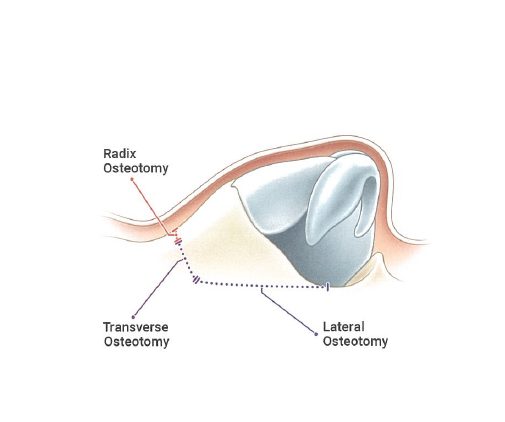
- Push-down / let-down: releasing the side nasal bones so the whole roof lowers, with the method depending on the width and shape of the bony base
The Advantage of No "Open Roof"
When a hump is shaved down in the structural method, the roof at the top of the bridge opens up and exposes a flat cut surface — this is called an "open roof." Left as-is it can make the bridge look wide and flat, so it is usually closed again with osteotomies that bring the side bones together and with spreader cartilage grafts. Because preservation rhinoplasty never opens the roof in the first place, that step is unnecessary — which brings the following advantages.
- Natural line preserved: it favors keeping the original curve (dorsal line) of the bridge.
- Fewer grafts: the need for spreader cartilage grafts to fill the open roof is often reduced.
- Tissue preservation: the roof, along with surrounding mucosa and ligaments, is preserved, which can be favorable for recovery (varies by individual).
- Lower irregularity risk: it can help reduce variables such as minor step-offs or inverted-V deformity that may arise when closing the roof.
Which Noses Does It Suit Best? — What the Surgeon Checks on Exam
These advantages come through when the nose meets the right conditions. On examination, the following are assessed together to judge suitability.
- Shape of the hump: the gentler the curve (V-shaped), the better the fit; a dipped, S-shaped contour tends to leave residual irregularity if the surface is simply lowered, so it is approached cautiously
- Bridge deviation: with significant side-to-side deviation, preserving the surface alone may not correct the deviation adequately
- Skin thickness and tip support: very thin skin or weak tip support can affect predictability and maintenance, so these are evaluated as well
Preservation vs. Structural — How the Choice Is Made
The two are not a matter of one being superior, but of which fits a given nose. The approaches diverge especially on whether an "open roof" is created.
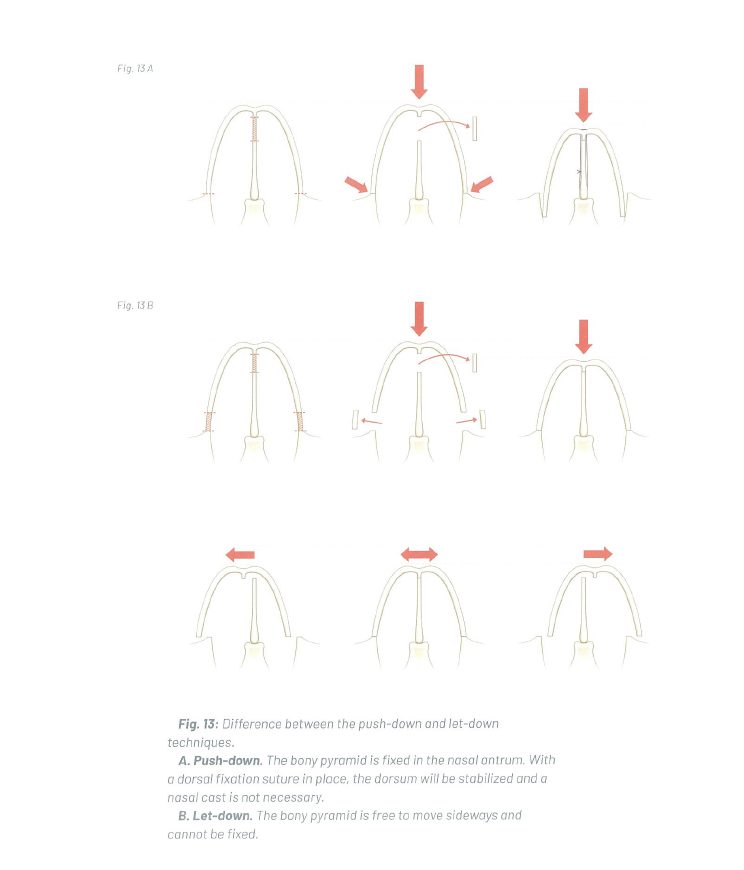
When the bony base is narrow, a push-down (lowering without a basal osteotomy) is considered; when it is wide, a let-down (removing a wedge of bone) may be chosen instead.
What About Recovery and Limitations?
It is a technique with clear advantages, but it does not apply equally to every nose, and its limitations are stated honestly.
- Swelling and bruising: because bone is involved, bruising around the eyes can occur; much of the early swelling typically settles over 2–3 weeks, while subtle residual swelling stabilizes over several months (varies by individual).
- Hump recurrence: a lowered bridge can, in some cases, rise partway back over time.
- Limited suitability: it may not fit an S-shaped hump or large deviation, where the structural method or a combination can be preferable.
Summary
The greatest advantage of preservation rhinoplasty is that by "keeping and lowering" the bridge rather than shaving it, it does not create an open roof — which in turn reduces grafting and favors preserving a natural bridge line. Because this advantage comes through when the nose meets the right conditions (a gentle hump, a smooth line), whether it suits you is best judged through in-person examination of your bone and cartilage structure and an individual assessment.
Frequently Asked Questions (FAQ)
Q1. What is the biggest advantage of preservation rhinoplasty?
A1. The hump is not shaved, so no "open roof" is created. With less need for the osteotomy and grafting used to close the roof, it favors preserving a natural bridge line (varies by individual).
Q2. If no open roof forms, are cartilage grafts never needed?
A2. The need to graft the roof is often reduced, but if the tip or bridge needs reinforcement, grafts may be used alongside. Whether they are needed depends on the nose.
Q3. Is preservation rhinoplasty possible for a deviated nose?
A3. Mild deviation can be addressed together, but a large deviation or pronounced curve may be better suited to the structural method or a combination, so an examination is needed.
Q4. How long is recovery?
A4. Much of the early swelling typically settles over 2–3 weeks, and subtle swelling stabilizes over several months. The actual course varies by individual.
Related Columns
Sources
- Korean Society of Plastic and Reconstructive Surgeons practice guidance (rhinoplasty-related)
- Standard rhinoplasty textbooks and dorsal preservation rhinoplasty literature (including Cottle's push-down/let-down concepts)
- Teorhinoplasty 2
Author: Dr. Jihun Kim, Board-Certified Plastic Surgeon
Published 2026-08-05 · Last updated 2026-08-05
※ This column is provided for general medical information and does not replace diagnosis or treatment for an individual patient. Indications, recovery, and possible side effects of surgery vary by individual; an in-person consultation and individual assessment by a specialist are needed for an accurate judgment.