Why is the nasal tip firm after rhinoplasty?

Why is the nasal tip firm after rhinoplasty?
A firm nasal tip after rhinoplasty is, in most cases, part of normal recovery. As swelling and scar tissue form at the surgical site, they harden and then mature, so the tip can feel firm and often softens gradually over time. That said, whether it is normal healing or another cause depends on when the firmness started, where it is, and whether findings such as redness, pain, or tip lifting accompany it (varies by individual).
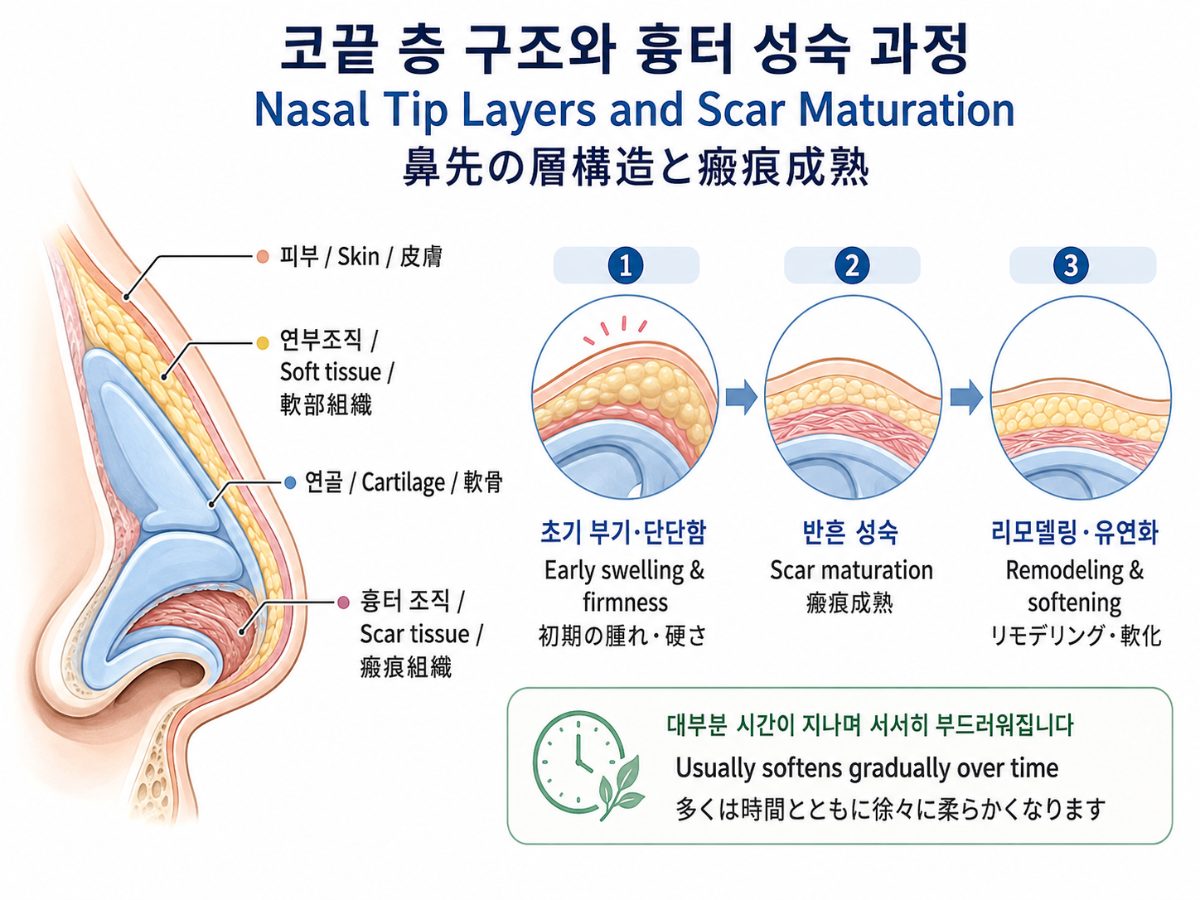
Why does the tip feel firm?
The nasal tip is a region where soft tissue and cartilage layer beneath the skin. After surgery, these layers swell, and scar tissue forms as they heal. This scar tissue is firm early on and gradually softens over several months as it remodels.
- Swelling: right after surgery, fluid accumulates in the tissue, so the tip swells and feels firm.
- Scar maturation: the scar from healing is firm for the first few months, then slowly becomes more pliable.
- Graft cartilage: if autologous cartilage was grafted at the tip, that area can feel relatively firm on palpation.
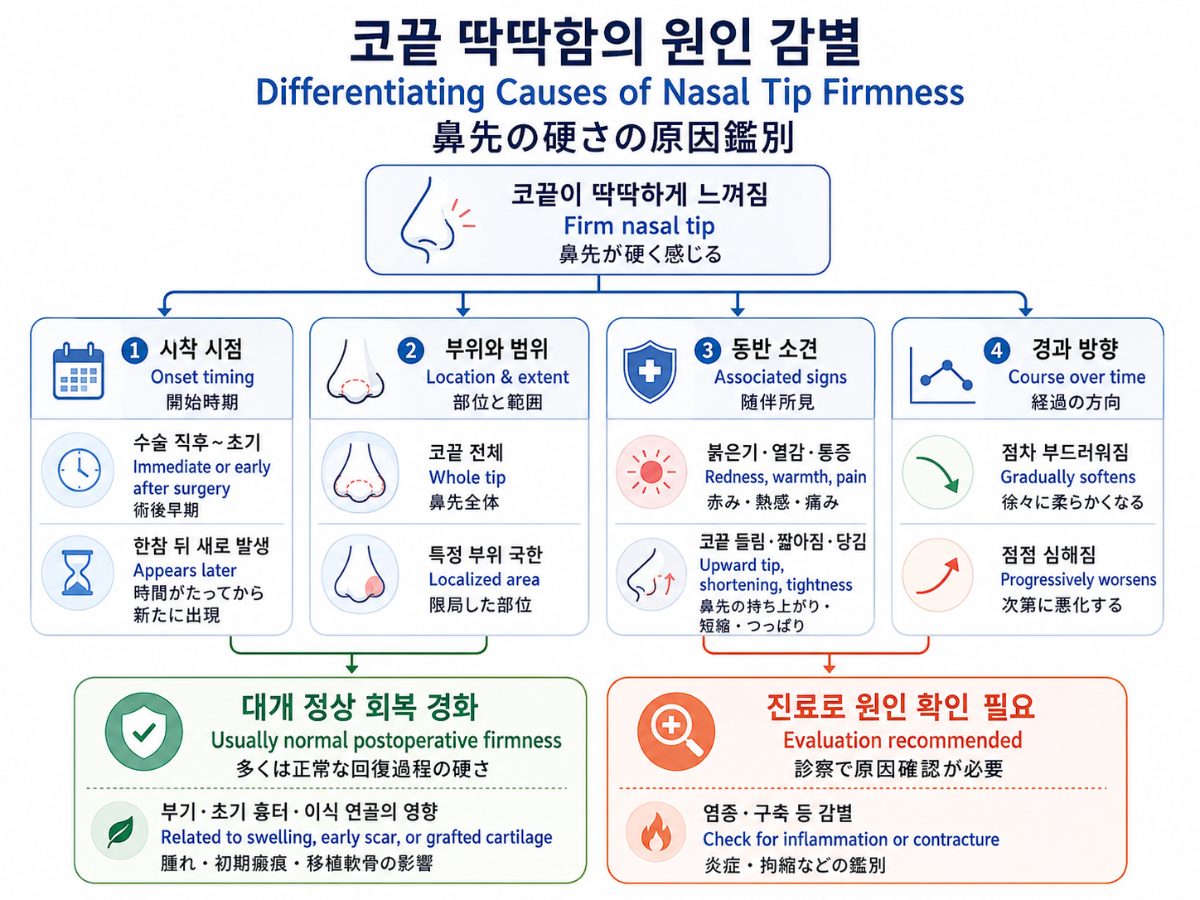
In other words, early firmness of the tip is often a common recovery response. What matters is distinguishing "simple recovery firmness" from "a sign that needs attention."
How is the firmness distinguished?
Even for the same complaint of "a firm tip," the exam checks the following together to tell the cause apart.
- Onset: from right after surgery (swelling, early scar) or newly appearing much later (possible late change).
- Site and extent: the whole tip, or limited to a specific graft area.
- Accompanying findings: redness, warmth, pain (suggesting inflammation); tip lifting, shortening, tightness (suggesting early contracture); or firmness alone.
- Direction of course: gradually softening over time, or instead worsening.
If redness or pain accompanies it, or the firmness worsens over time with the tip appearing lifted, it may be a sign of inflammation or contracture rather than simple recovery firmness, and a consultation is needed. When necessary, judgment may follow an exam and imaging of the tissue around the implant or cartilage. (For late-appearing contracture, see the related column.)
What is the usual course?
Below is a general range to aid understanding; it varies with the surgical method, individual constitution, and graft material (varies by individual).
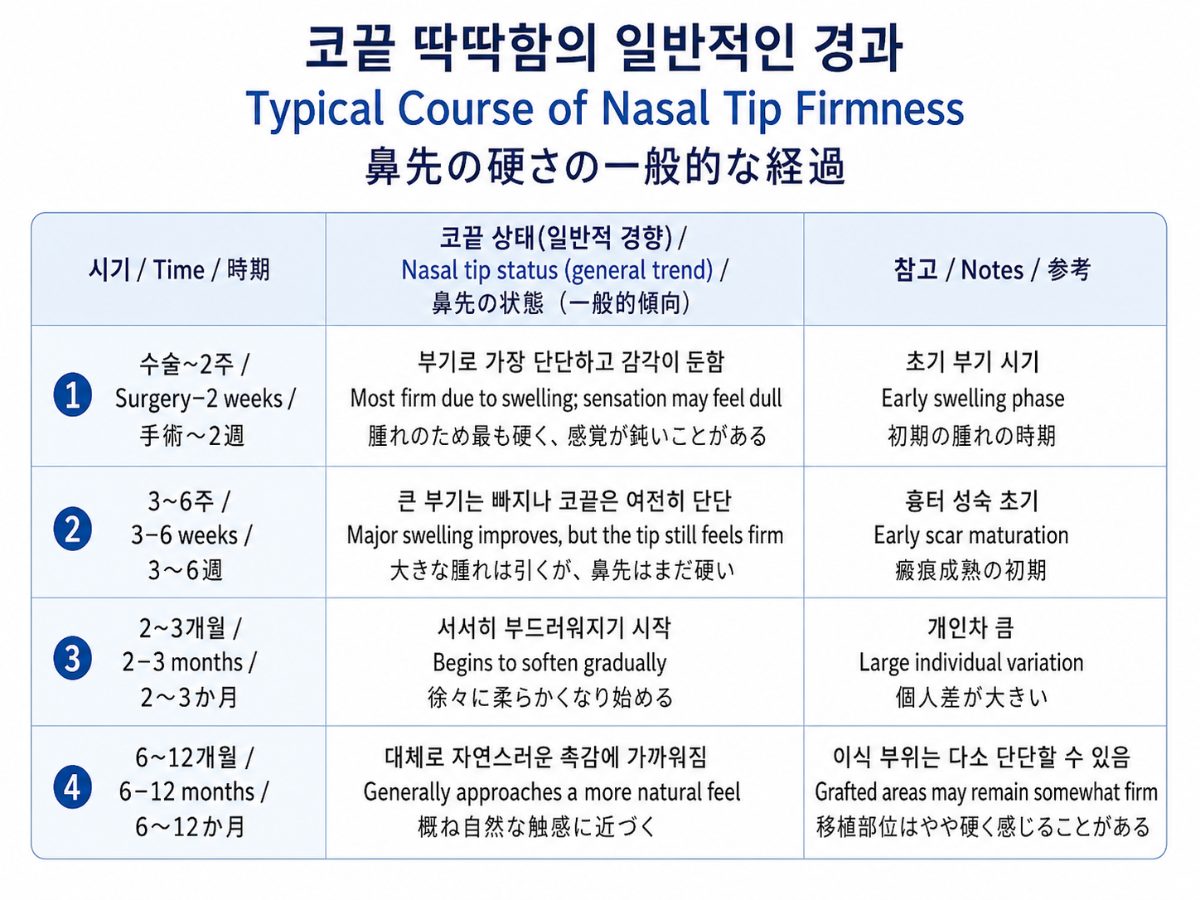
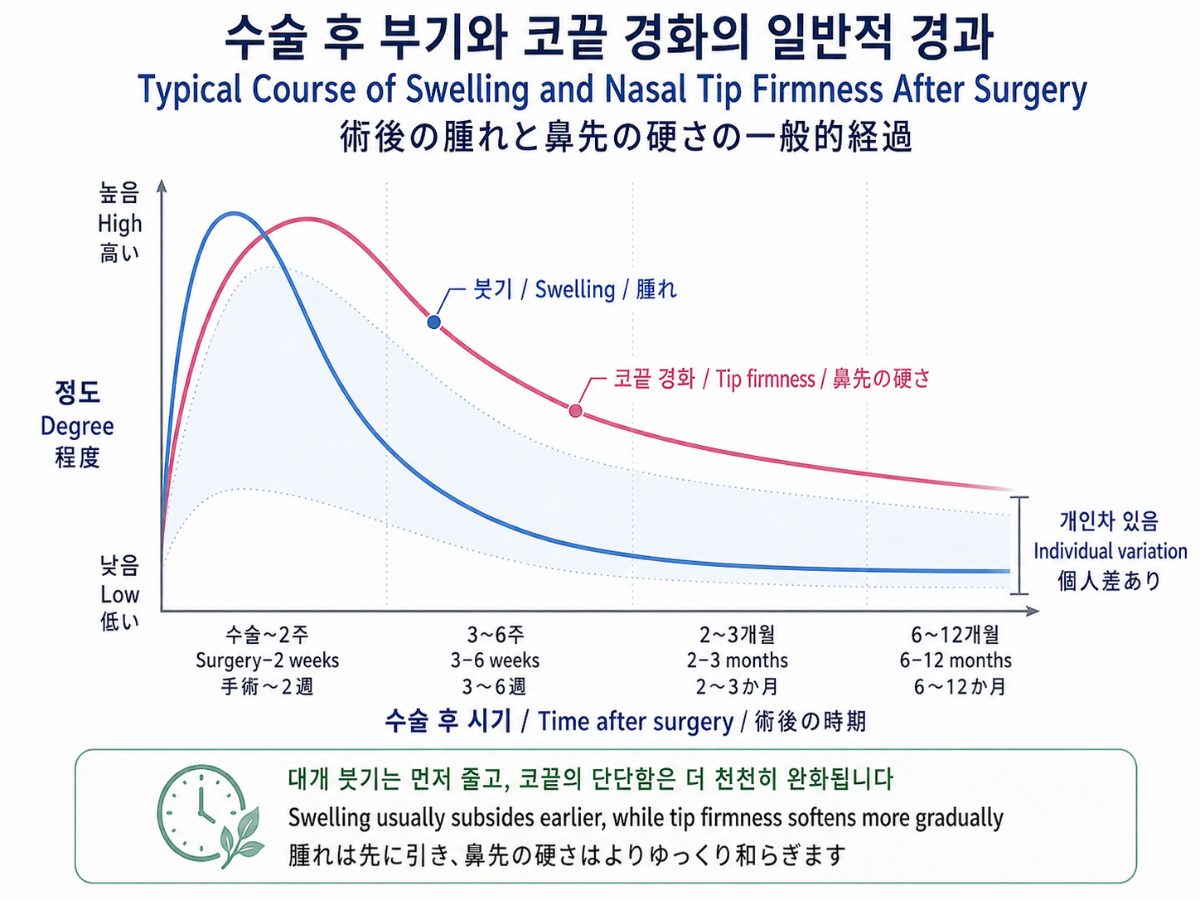
In short, tip firmness is mostly a recovery response that time resolves, but if redness, pain, progressive worsening, or tip lifting accompany it, the cause should be distinguished. When self-judgment is difficult, confirming it with an in-person exam is the safe course.
Frequently Asked Questions (FAQ)
Q1. My tip is firm—can I massage it?
A. It depends on the timing and condition. Early on, the tissue is sensitive, and excessive stimulation may not help; whether and how to massage varies with the surgical method, so it is safest to confirm through your own clinician.
Q2. When does it soften?
A. Major swelling usually subsides within a few weeks, but tip firmness eases more slowly, often approaching a natural feel over several months to a year (varies by individual).
Q3. Is it a problem if firmness persists?
A. Graft areas can feel somewhat firm on palpation, so that alone does not necessarily mean a problem. However, if pain, redness, progressive worsening, or shape change accompany it, the cause should be distinguished.
Q4. What if the tip also looks lifted along with the firmness?
A. If firmness comes with the tip lifting, feeling shortened, or a sense of tightness, it may be an early sign of contracture, so it is advisable to confirm with a consultation.
Q5. Is dulled sensation also normal?
A. Temporary reduced sensation after surgery is common and often improves over several months as nerves recover. Still, the pace of recovery can differ by individual.
Related columns
- How should late-appearing contracture after rhinoplasty be approached?
- How do ear cartilage and septal cartilage differ in rhinoplasty?
- What aftercare shapes recovery after rhinoplasty?
Sources
- Academic materials of the Korean Society of Plastic and Reconstructive Surgeons (KSPRS) and rhinoplasty-focused societies — principles of soft-tissue healing, scar maturation, and graft palpability
- Standard rhinoplasty-textbook principles (post-operative edema and scar-maturation course; general concepts for distinguishing contracture and inflammation)
- The above summarizes generally verifiable society- and textbook-level principles; individual indications and course vary with the clinical situation.
Author · Reviewer · Date
- Author: Dr. Kim Ji-hun, Board-Certified Plastic Surgeon (VVLY Plastic Surgery Clinic )
- Published: 2026-08-26 · Last updated: 2026-08-26
※ This column is intended to provide general medical information and does not replace diagnosis or treatment for an individual patient. Indications, recovery, and possible side effects of a surgery or procedure vary by individual, and an in-person consultation and individual assessment by a specialist are needed for an accurate judgment.