Is Alar Reduction Enough to Correct a Bulbous Nose?

A "bulbous" nose is not a single condition. It can result from wide alar bases, a broad or low tip cartilage framework, thick tip skin and soft tissue, or any combination of these. Alar reduction acts only on the alar base, so if the broad tip stems from cartilage or skin, alar reduction alone may produce limited change. The first step is therefore to work out which components contribute and by how much; this varies from person to person.
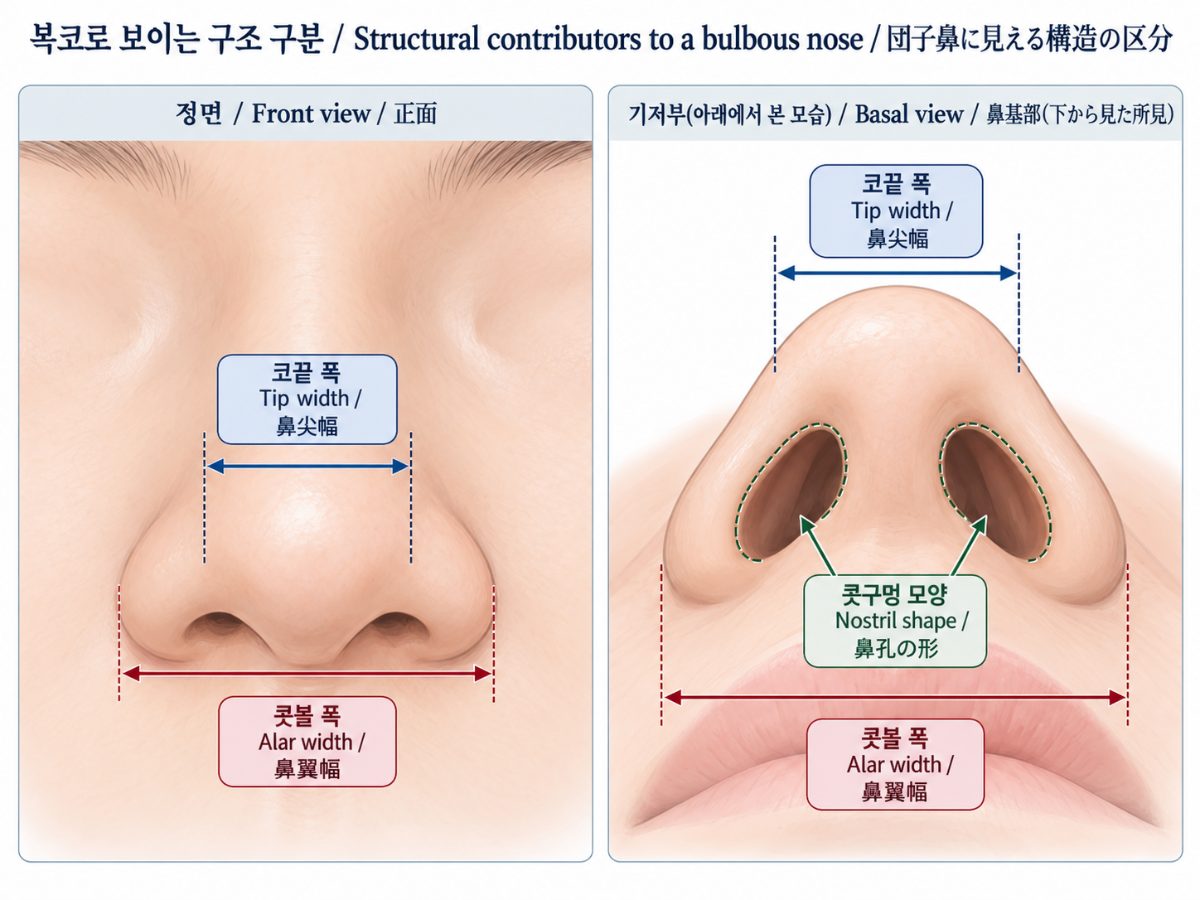
How are the causes of a bulbous nose separated?
A broad, rounded tip generally arises from three overlapping structures.
- Alar component: broad or flared alar bases, or nostril sills that spread outward.
- Tip cartilage component: wide domes of the lower lateral cartilages, or weak cartilage that lets the tip look low and spread.
- Skin and soft-tissue component: thick skin and subcutaneous tissue that rounds the contour even when the underlying framework is similar.
| Component | Typical appearance | Structures involved | Approach commonly considered |
|---|---|---|---|
| Alar | Alae appear wider than the distance between the inner corners of the eyes; flared nostrils | Alar base, alar skin and muscle | Excision at the alar base or nostril sill (alar reduction) |
| Tip cartilage | Wide, low tip; rounded rather than triangular on base view | Lower lateral cartilages (domes, medial crura) | Suture techniques to reshape; cartilage grafts when support is needed |
| Skin / soft tissue | Contour may stay soft even after the framework is refined | Tip skin thickness, subcutaneous fat and connective tissue | Soft-tissue refinement is limited; expectations are planned accordingly |
In practice, most noses show two or three of these at once rather than just one.
What is checked at examination?
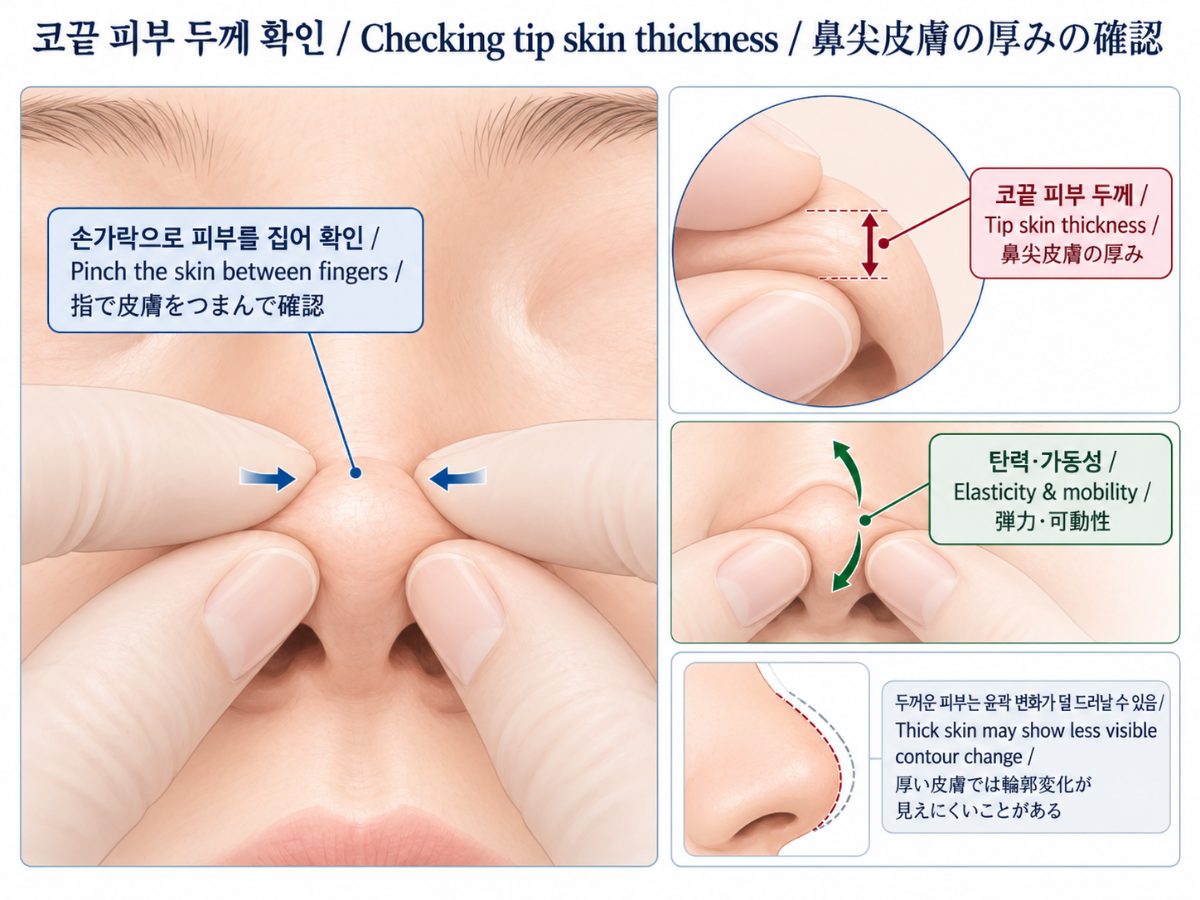
The following points are assessed together.
1. Frontal alar width: compared with the intercanthal distance. This is a reference, not a target; the appropriate width depends on overall facial balance.
2. Base view: nostril shape, tip projection, and the direction in which the alae flare.
3. Tip skin thickness: assessed by pinching. When skin is thick, reshaping the cartilage may produce a smaller visible change.
4. Tip cartilage strength: assessed by palpation. Weak cartilage may not hold a new shape with sutures alone, which is when a graft is considered.
5. Breathing: whether the alar region or internal nasal valve is already narrow. Because alar reduction can affect nostril size and alar support, any existing nasal obstruction is reviewed first.
Only by combining these findings can cases where alar reduction may suffice be separated from those where the tip itself needs to be addressed.
How is the technique chosen?
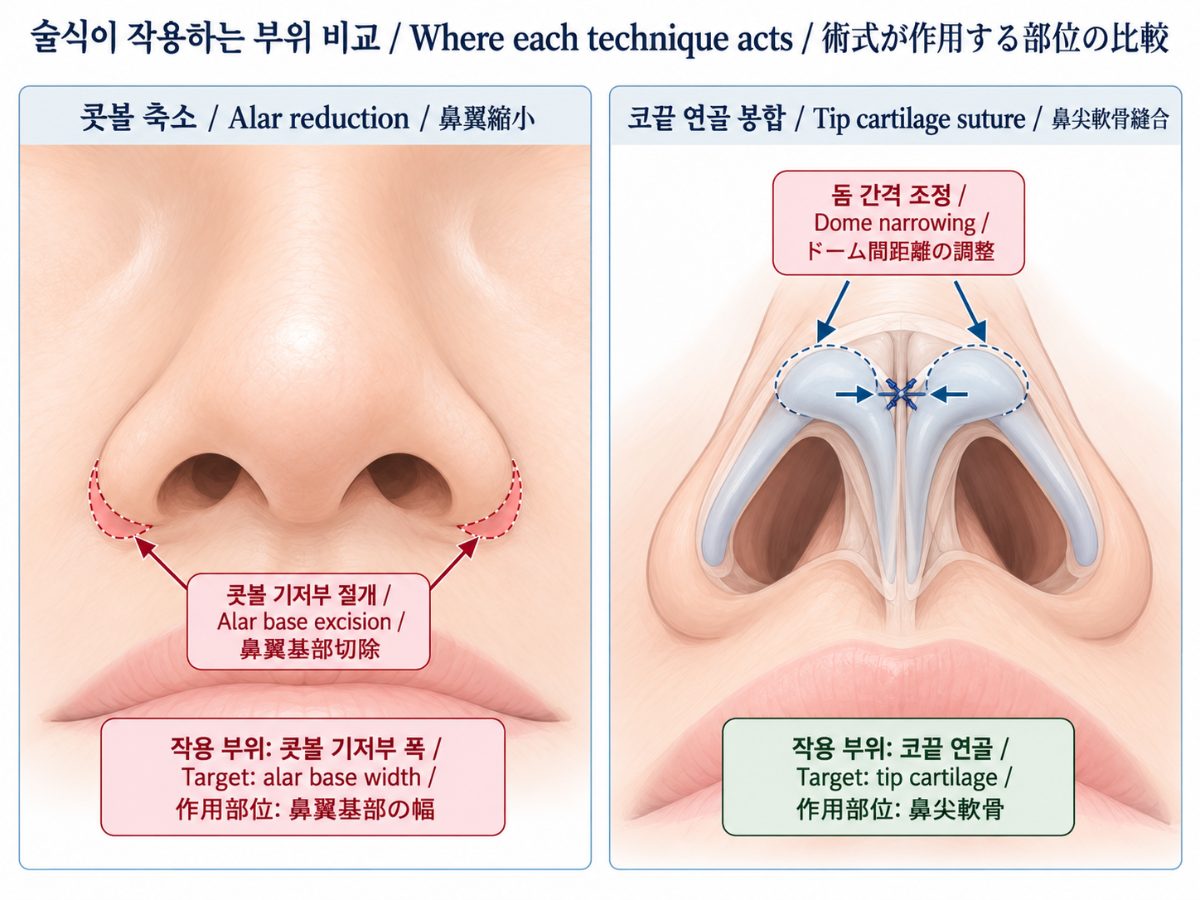
Alar reduction works by removing a small amount of tissue at the alar base or nostril sill and closing the incision, adjusting alar width and nostril shape. The incision is planned along the alar–facial groove, but how visible the scar becomes, left–right asymmetry, and changes in nostril shape vary between individuals, and additional treatment is occasionally needed.
Tip refinement, by contrast, typically uses sutures to narrow the dome spacing and, when needed, selective cartilage trimming with graft reinforcement. Over-resection can cause tip collapse or breathing difficulty, so preserving an adequate width and support of the remaining cartilage is central. How grafting material is chosen is discussed in How Do Ear Cartilage and Septal Cartilage Differ in Rhinoplasty?.
In summary:
- Alar component dominant: planning centers on alar reduction, with the explanation that the effect may be limited if the tip is also broad.
- Tip cartilage component dominant: cartilage suturing or grafting is considered before alar incisions.
- Thick skin: the visible change from framework refinement may be modest, so limits are discussed before planning. For the opposite situation, see Why Can an Implant Show Through Thin Nasal Skin?.
- Revision cases or a firm-feeling tip: prior surgery may influence the findings; see Why Does the Nasal Tip Feel Hard After Surgery?.
How diagnostic reasoning works in practice (anonymized reasoning, not a before/after case)
Some patients come in feeling that the alae are wide, yet on base view the dome spacing is wide and the tip skin is thick, while alar width is not markedly beyond the intercanthal distance. That pattern — a broad-looking tip without a markedly wide alar base — is the clue. In such a finding, the approach is not to widen the alar excision but to evaluate tip cartilage and skin thickness first. This describes how findings change the decision, not an outcome comparison.
Summary
- A bulbous nose reflects alar, tip-cartilage, and skin/soft-tissue components, alone or combined.
- Alar reduction acts only on the alar base, so its effect may be limited if the cause lies in cartilage or skin.
- Examination covers alar width, base-view shape, skin thickness, cartilage strength, and breathing.
- The extent of change and the possibility of scarring or asymmetry vary individually, so in-person assessment is needed.
Frequently Asked Questions
Q1. Does alar reduction leave a scar?
A. It requires an incision, so a fine linear scar can occur. Incisions are planned along the alar–facial groove or inside the nostril to be less noticeable, but visibility varies with skin type and healing.
Q2. Will reducing the alae alone make the tip look more refined?
A. Alar reduction adjusts alar width and nostril shape but does not directly change the tip cartilage or skin thickness. If those are the main cause, the change may be limited.
Q3. Is surgery harder when the tip skin is thick?
A. The visible contour change from reshaping the framework can be smaller with thick skin, so goals are set realistically. This does not mean surgery is not possible; individual assessment is needed.
Q4. Can breathing become harder after alar reduction?
A. Narrowing the nostril too much or affecting its support can make breathing less comfortable. This is why existing nasal obstruction and the alar and valve area are checked at examination, and the amount removed is planned conservatively.
Q5. Is a cartilage graft always needed for the tip?
A. No. If cartilage strength and projection are adequate, sutures alone may be enough; grafts are considered when support is insufficient.
Related columns
- How Do Ear Cartilage and Septal Cartilage Differ in Rhinoplasty?
- Why Can an Implant Show Through Thin Nasal Skin?
- Why Does the Nasal Tip Feel Hard After Surgery?
Sources
- Rohrich RJ, Adams WP Jr, Ahmad J, Gunter JP (eds). *Dallas Rhinoplasty: Nasal Surgery by the Masters.* (chapters on tip suture techniques and alar base surgery)
- Neligan PC (ed). *Plastic Surgery* (Elsevier), rhinoplasty chapters
- Note: these are general textbook-level references; specific chapters, editions and years are to be confirmed by the editor before publication.
Author · Reviewer · Dates
- Author: Dr. Jihun Kim, Board-Certified Plastic Surgeon (VVLY Plastic Surgery Clinic)
- Published: 2026-10-21 · Last updated: 2026-10-21
※ This column provides general medical information and does not replace diagnosis or treatment for an individual patient. Indications, recovery, and possible complications vary between individuals; an in-person consultation and individual assessment by a specialist are necessary.