Why Does a Nasal Implant Show Through Thin Nose Skin?

When the nose skin is thin, an implant shows through because the skin and the soft tissue beneath it cannot fully mask its light and color. To answer directly: show-through is not caused by "thin skin" alone — it results from a combination of the implant's type, edge finishing, and depth of placement, together with changes over time. It is especially likely to stand out at the thin-skinned tip or along the implant edges. In such cases the risk is reduced by material choice, tissue-layer placement, and autologous coverage, and which approach fits is decided by first checking skin thickness and cause on examination (results vary by individual).
Why does an implant show through thin skin?
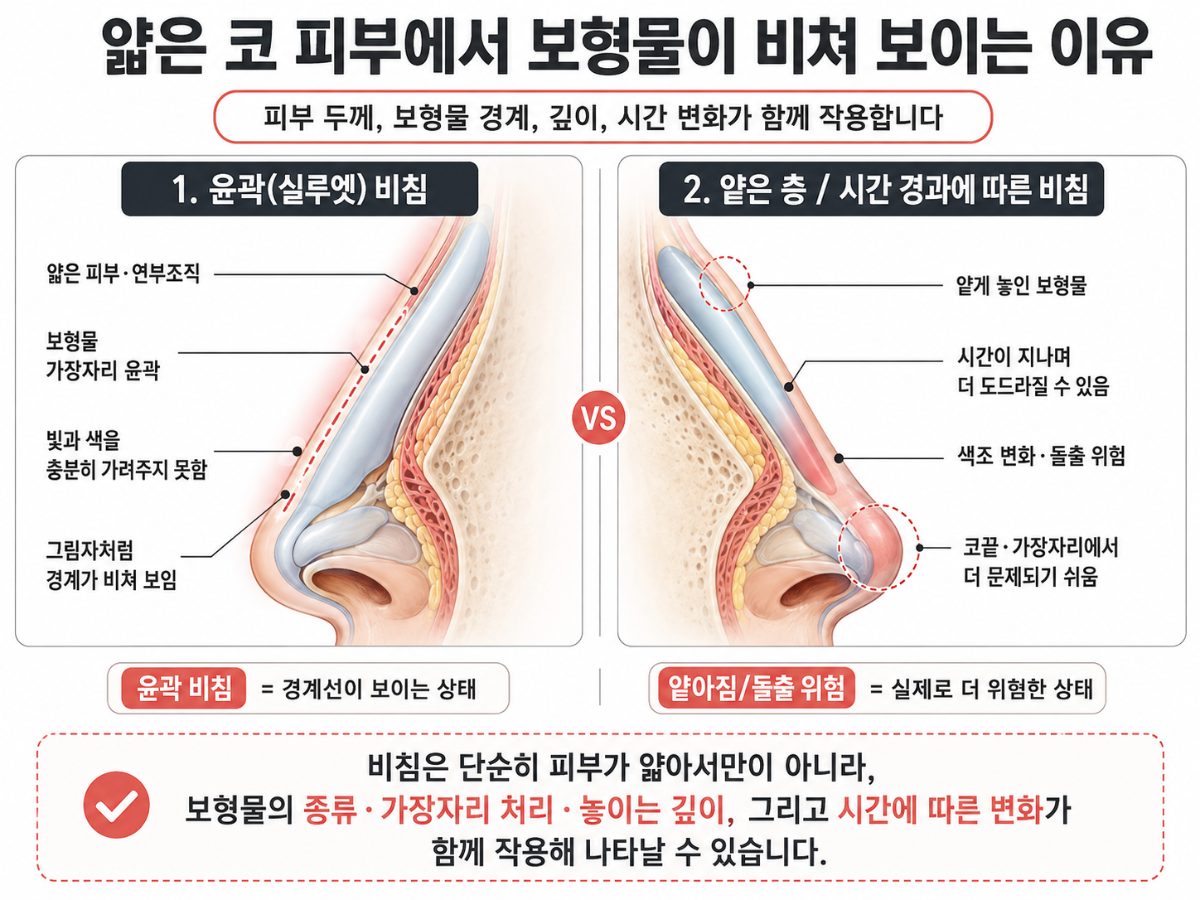
Nose skin varies in thickness by region. The mid-dorsum is relatively thin, while the tip is thicker due to sebaceous glands — though this varies widely between people. When the skin, fascia, and soft tissue are thin, the boundary of the implant beneath can appear like a shadow, or the characteristic color of silicone can faintly show.
Show-through is best considered in two forms. One is the implant's "silhouette" showing through — more pronounced when edges are angular or thick. The other is when the implant sits shallow toward the skin, or has migrated upward over time, so that actual protrusion is imminent. Because these two require different responses, distinguishing them on examination is important.
Can material and surgical technique reduce show-through?
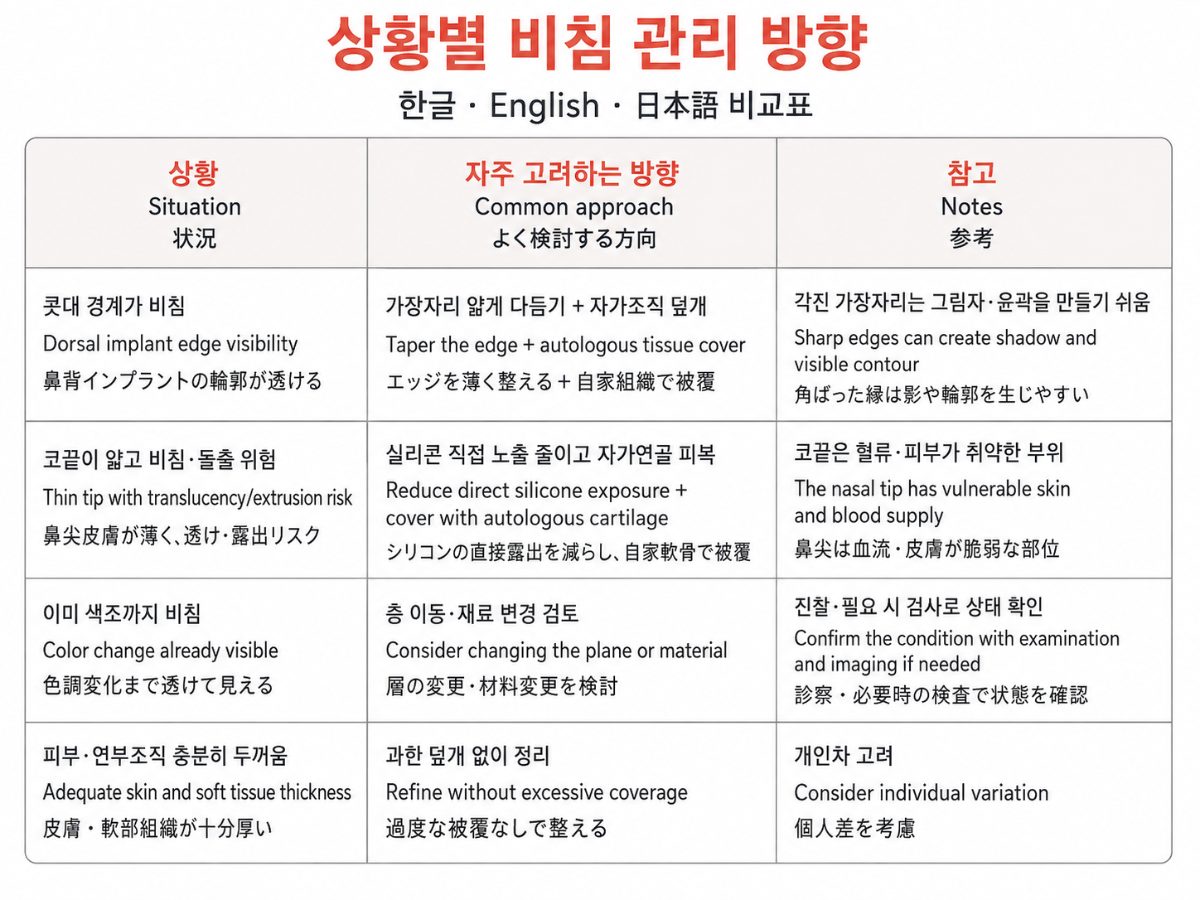
When the skin is judged to be thin, material and layer placement are adjusted to lower the risk. The general criteria we refer to are as follows (examination comes first, and they are not applied uniformly to every nose).
- When the skin is thin and the dorsal implant edge risks showing, we consider keeping a firm silicone thin, tapering its edges, and placing autologous tissue such as cartilage, fascia, or dermis over it to soften the boundary.
- For especially thin areas such as the tip, where show-through and subsequent protrusion risk are high, we prioritize covering or supporting with autologous cartilage (ear/septal) rather than placing silicone directly.
- Conversely, when the skin and soft tissue are sufficiently thick and blood supply is good, the nose may be managed with the implant alone, without adding multiple layers of coverage.
- If show-through or color change is already marked, or the skin has become very thin, moving the implant from a shallow to a deeper layer, or changing its type, may be considered.
What is checked on examination, and when are tests needed?
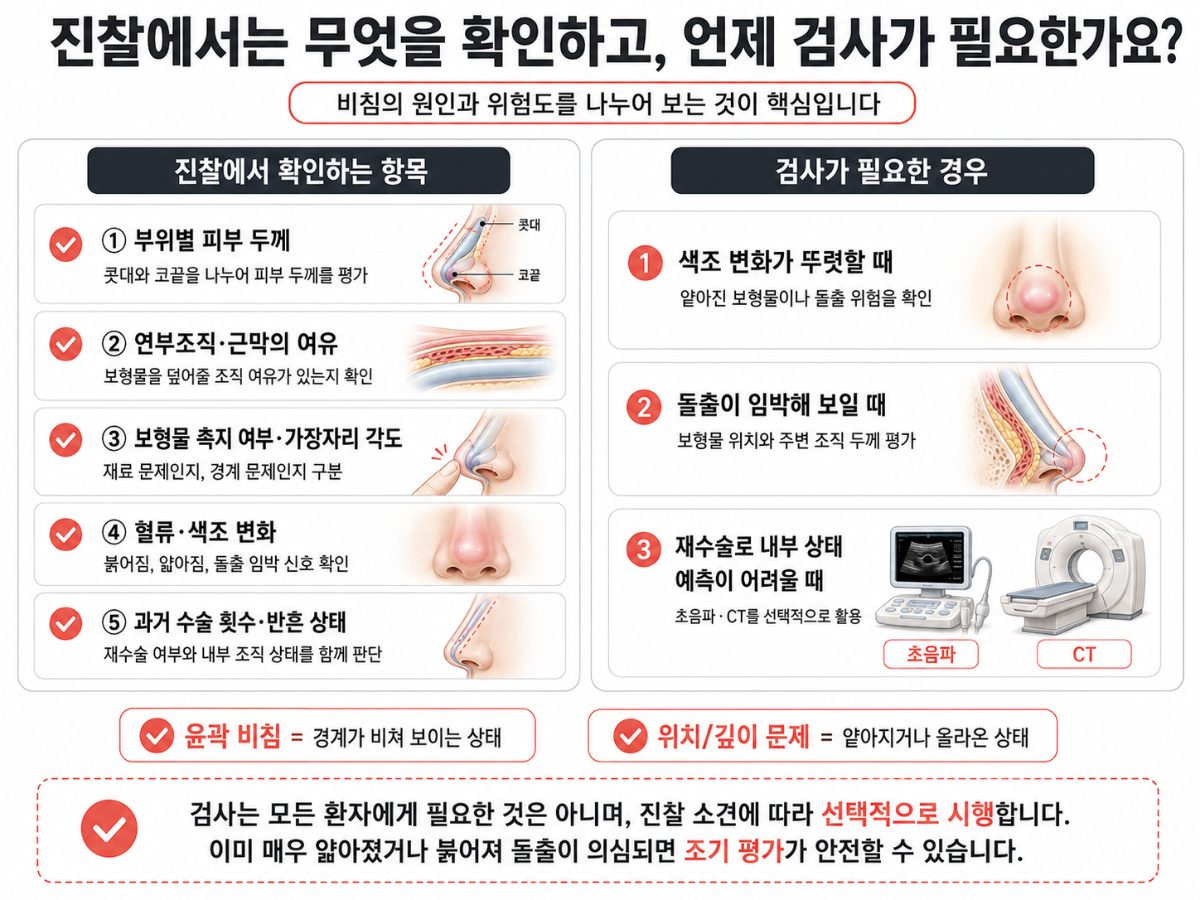
Before addressing show-through, examination looks at: (1) regional skin thickness (assessing dorsum and tip separately by pinch and palpation); (2) the reserve of soft tissue and fascia beneath the skin; (3) whether an existing implant is palpable and its edge angle; (4) skin blood supply and color change (redness or thinning); and (5) the number of prior surgeries and scar condition. These help distinguish whether show-through is a "material/edge issue" or an "implant-too-shallow/migrated issue."
When color change is marked, protrusion appears imminent, or a revision makes internal status hard to predict, ultrasound or CT may be used to confirm implant position and surrounding tissue thickness before deciding direction. Tests are not needed for every patient and are performed selectively based on findings. If the skin is already very thin or reddened and protrusion is suspected, early assessment can be safer than waiting.
Summary
Show-through in thin skin is not a matter of skin thickness alone — implant type, edges, depth, and changes over time all contribute. Softening edges and adding autologous coverage, or adjusting material and layer, can reduce the risk, and what fits is decided by exam findings such as regional skin thickness, soft tissue, and blood supply. When color change or protrusion is suspected, tests are used as adjuncts. Because individual variation is large, an accurate judgment requires an in-person examination and individual assessment by a specialist.
Frequently Asked Questions (FAQ)
Q1. If show-through appears, is revision surgery always required?
A. Mild silhouette show-through may be observed over time. However, if color change progresses or the skin thins with suspected protrusion, early assessment may be needed.
Q2. Does autologous cartilage coverage prevent show-through entirely?
A. Autologous coverage can help lower the risk by softening the boundary, but with very thin skin it cannot be said to eliminate it entirely. Results vary by individual.
Q3. Does show-through worsen over time?
A. It can become more pronounced if the skin thins or the implant migrates upward. In other cases it stays stable, so the course varies by individual.
Q4. Do GORE-TEX or autologous tissue alone avoid show-through instead of silicone?
A. Each material has different properties and trade-offs, so show-through tendencies differ, but no material can guarantee zero show-through in thin skin. Material choice is judged together with the skin condition.
Q5. Which shows through more easily, the tip or the dorsum?
A. It varies between people, but show-through and protrusion risk are often more of a problem at the tip, where thin skin and fragile blood supply overlap.
Sources
- Korean Society of Plastic and Reconstructive Surgeons — standard textbook and rhinoplasty practice guidance
- Standard rhinoplasty textbook (implant / autologous grafting: general principles on skin thickness and graft show-through/exposure)
- ※ Specific paper titles/years are cited only where verifiable; this column summarizes general principles at the textbook / society-guideline level.
Related columns
- Ear Cartilage vs. Septal Cartilage: How Do They Differ in Rhinoplasty?
- What is preservation rhinoplasty?
- Can you have nose surgery after thread lifting?
Author · Reviewer · Dates
- Author: Dr. Jihun Kim, Board-Certified Plastic Surgeon
- Published: 2026-08-19 · Last updated: 2026-08-19
※ This column is intended to provide general medical information and does not replace diagnosis or treatment for an individual patient. Indications, recovery course, and possible side effects of surgery or procedures vary by individual, and an accurate judgment requires an in-person examination and individual assessment by a specialist.