When Should a Nasal Implant Be Removed During Revision Rhinoplasty?

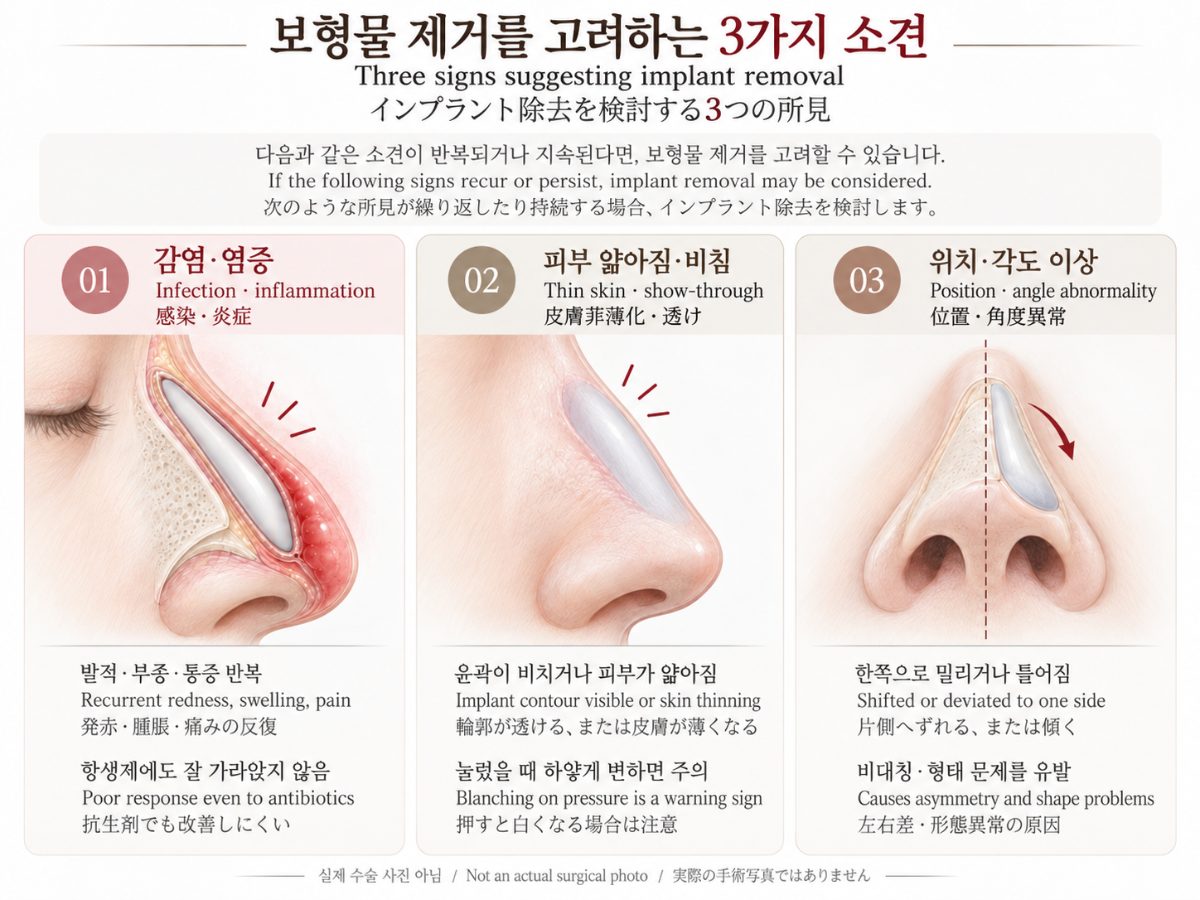
One of the most common questions in revision rhinoplasty consultations is whether the existing implant has to come out. In short: removal is generally considered when infection or inflammation does not resolve, when the skin has thinned to a point where the implant shows through or risks perforation, or when the implant has shifted or deformed enough to cause functional or aesthetic problems. When none of these signs are clearly present, repositioning the same implant or swapping it for a different material without full removal can also be an option. Which path fits depends on several findings checked during the exam, and outcomes vary by individual — an in-person evaluation is needed.
What Signs Indicate an Implant Must Be Removed?
During the exam, five findings are reviewed together:
1. Infection or chronic inflammation — recurring redness, swelling, or pain that does not settle with antibiotic treatment
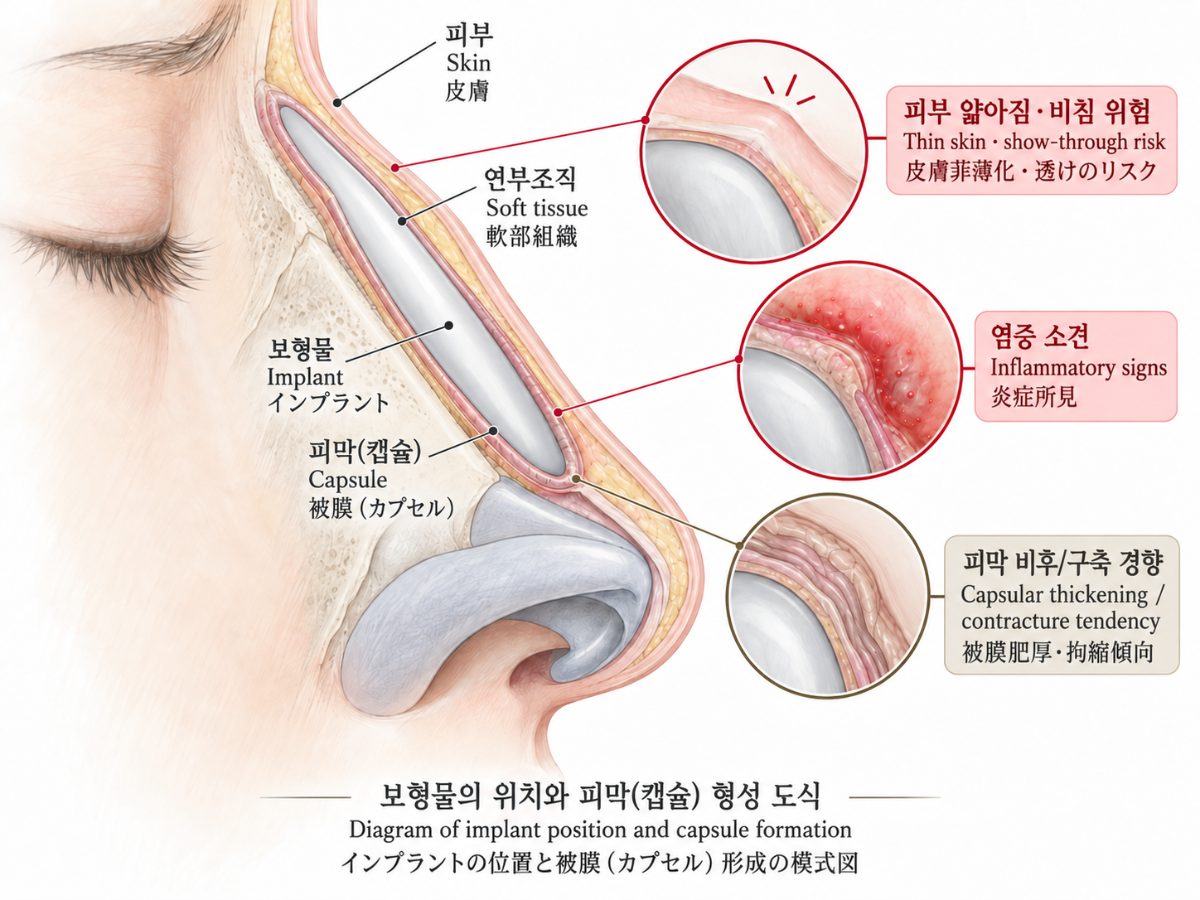
2. Skin thinning / show-through — the implant's outline becomes visible through thinning bridge skin, or the skin blanches under pressure (a warning sign for perforation)
3. Malposition or tilt — the implant has shifted to one side, worsening asymmetry
4. Capsular contracture — the fibrous capsule around the implant thickens, accompanied by tip elevation or shortening (contracture)
5. Persistent pain or foreign-body sensation — chronic pressure or discomfort without an obvious inflammatory finding
When infection, perforation risk, or significant contracture is confirmed, removal is usually prioritized; when only mild malposition is present, repositioning alone may resolve it without removal. In other words, the implant's age by itself is not a direct reason for removal — the decision rests on the combination of findings above.
Can Reconstruction Happen Right After Removal, or Is a Waiting Period Needed?
When infection is involved, the standard approach is to remove the implant and observe until inflammation has fully resolved before proceeding with reconstruction. If the issue is purely positional or structural with no infection, removal and reconstruction can sometimes be done in the same operation. This decision weighs inflammatory markers, tissue condition, and the number of prior surgeries, so it is not applied uniformly (individual variation applies).
How Is the Replacement Material Chosen?
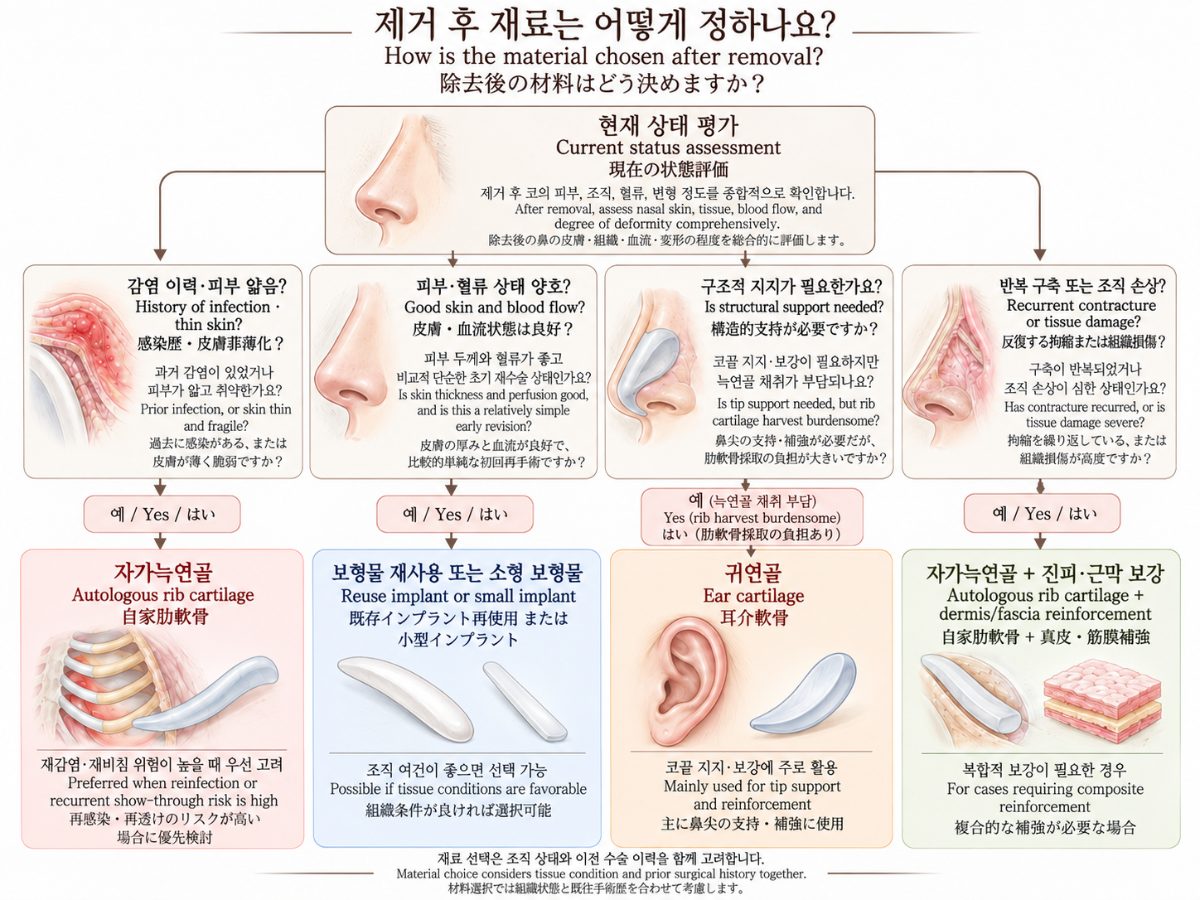
| Situation | Material considered | Selection / exclusion criteria |
|---|---|---|
| Revision with a history of infection and thin skin | Autologous rib cartilage | Reusing synthetic material carries higher re-infection/show-through risk, so autologous tissue is prioritized |
| Good skin and blood supply, first revision | Reused silicone/Gore-Tex or a smaller implant | With favorable tissue conditions, synthetic material can sometimes be managed without escalating to rib cartilage |
| Structural support needed but rib cartilage harvest is a concern | Ear (conchal) cartilage | Limited harvest volume means it is mainly used for tip support/reinforcement rather than full dorsal support |
| Severe recurrent contracture with significant tissue damage | Autologous rib cartilage plus dermis/fascia reinforcement | A single material alone carries recurrence risk, so a combined approach is considered |
Material choice weighs infection history, remaining skin and cartilage volume, the patient's desired bridge height, and the number of prior surgeries. CT or nasal endoscopy is used when chronic inflammation or nasal obstruction is suspected, to assess tissue around the implant and the internal nasal passage together.
Summary
- Implant removal is decided by specific findings — infection, show-through, malposition, contracture — not by how long the implant has been in place.
- Whether removal and reconstruction happen together or are staged depends on whether infection is present.
- Replacement material is chosen among autologous rib cartilage, ear cartilage, and synthetic material based on skin/blood-supply condition and infection history; there is no single correct answer.
- An in-person consultation and individual evaluation with a specialist are needed for an accurate decision.
FAQ
Q1. Does an implant need to be removed just because it has been in place for a long time?
A. No. Specific findings such as infection, show-through, or contracture matter more than how long the implant has been in place. If no clear problem exists, observation is sometimes continued even with an older implant.
Q2. Is it possible to remove the implant without replacing it right away?
A. Yes. When infection is severe or tissue condition is poor, the implant may be removed first, with reconstruction discussed later once the tissue has stabilized.
Q3. What happens to the scar from a removal procedure?
A. The existing incision from the prior surgery is generally reused, so an additional new scar is usually not created (individual variation applies).
Q4. Does the shape of the nose change after removal?
A. The bridge may appear lower by the volume the implant occupied, and the final shape depends on the timing and material of reconstruction.
Q5. Is removal ever recommended without visible inflammation?
A. Yes. If the skin has thinned enough that perforation risk is considered significant, removal may be recommended preventively even without clear inflammation.
Related Columns
- When Can Revision Rhinoplasty Be Performed After the First Surgery?
- Why Does a Nasal Implant Show Through Thin Nose Skin?
- Rib Cartilage in Rhinoplasty — Autologous vs. Donor Cartilage
- Contracted Nose Appearing Long After Rhinoplasty: How Is It Approached?
Sources
- Korean Society of Plastic and Reconstructive Surgeons — clinical guidance on rhinoplasty and revision surgery
- Clinical literature and standard reference texts on nasal implant complications (infection, show-through, capsular contracture)
Author · Reviewer · Date
- Author: Dr. Jihun Kim, Board-Certified Plastic Surgeon
- Published: 2026-09-23
This column provides general medical information and is not a substitute for individual diagnosis or treatment. Indications, recovery course, and possible side effects of any surgery or procedure vary by individual; an accurate assessment requires an in-person consultation and evaluation by a specialist.