When Can Revision Rhinoplasty Be Performed After the First Surgery?

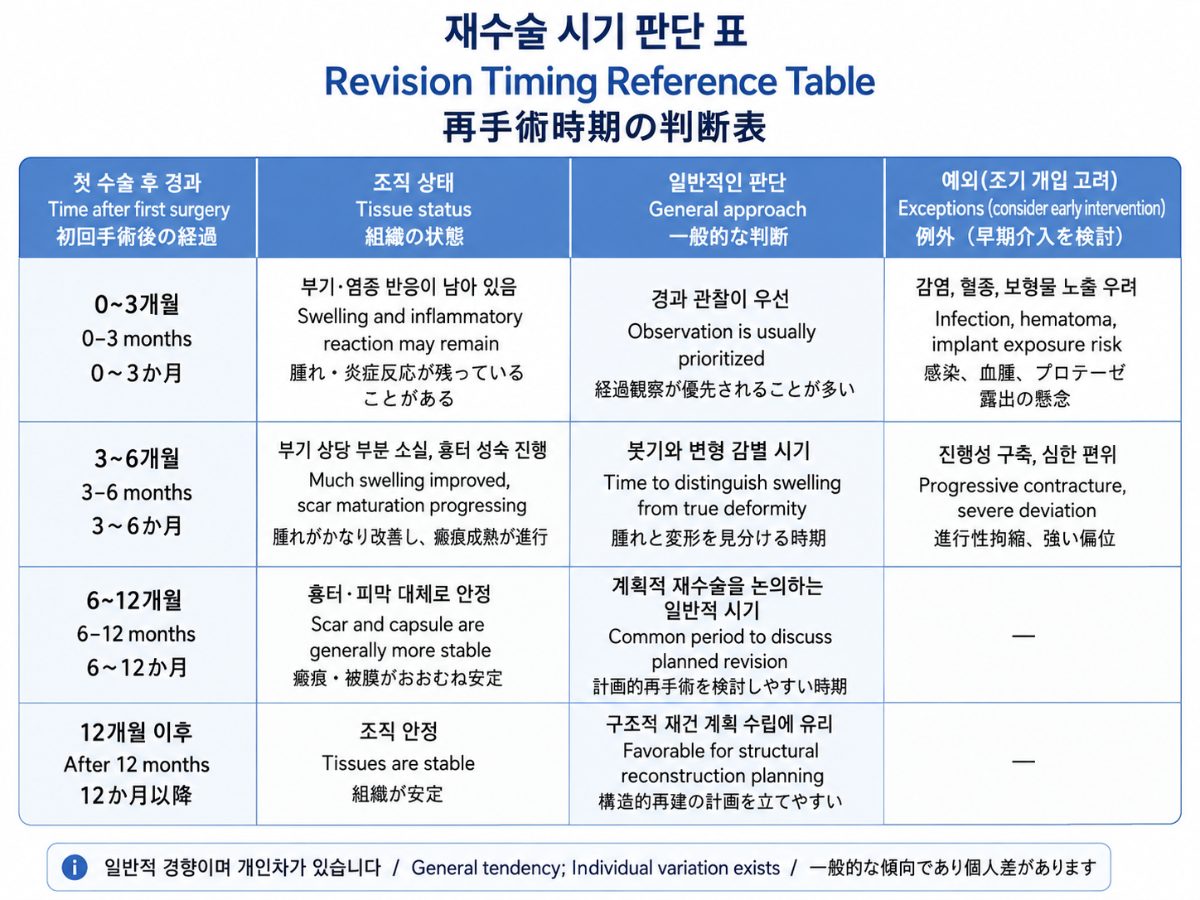
Revision rhinoplasty is most often planned 6–12 months after the primary operation, once swelling has largely resolved and the capsule and scar tissue have matured. Before the tissues have settled, the boundary between scar and healthy tissue is difficult to define, and re-elevating flaps while blood supply is still recovering can work against healing. That said, when waiting itself is disadvantageous — uncontrolled infection, or skin changes suggesting impending implant exposure — earlier intervention is considered regardless of how much time has passed. In practice, tissue condition and the nature of the problem guide the decision more than any fixed number of months, and this varies by individual.
Why is a 6–12 month interval usually advised?
A nose continues to change longer than it appears to. Roughly 70–80% of swelling subsides within 2–3 weeks, but in areas with thicker skin and more soft tissue — the tip in particular — subtle swelling settles gradually over 3–6 months, and in some cases up to 6–12 months (varies by individual).
Over the same period, a capsule and scar tissue form and mature around any implant or cartilage graft. Operating while that tissue is still soft and highly vascular is unfavourable in three ways. First, residual swelling makes the final contour hard to predict. Second, the plane between scar and healthy tissue is indistinct, so dissection carries a greater risk of tissue injury. Third, if perfusion of skin and soft tissue that is still recovering is reduced again, the risk of skin problems or recurrent contracture may rise.
For concerns limited to a line that does not yet look right, or mild asymmetry, it is therefore often reasonable to observe first and see how much resolves on its own.
When should the problem be addressed early rather than waited out?
Conversely, findings that tend to worsen over time are not deferred on the basis of an interval. Typical examples include infection that does not respond to antibiotic treatment; thinning, reddened, tender skin raising concern for impending implant exposure; marked implant displacement or extrusion; haematoma; and structural nasal obstruction that interferes with breathing.
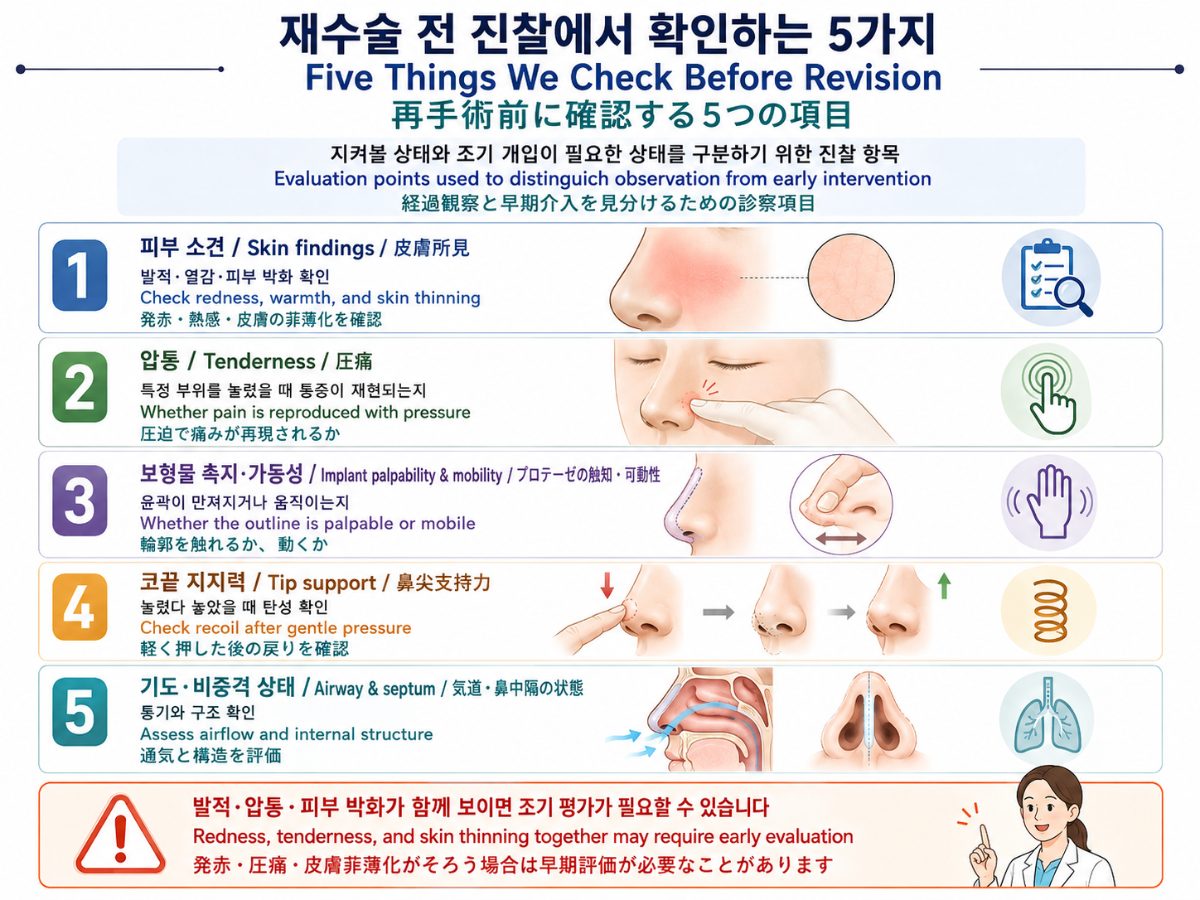
On examination, five findings are assessed together to separate "observe" from "intervene early":
- Skin findings: localized redness, warmth, or areas of thinning
- Tenderness: whether pressure over a specific point reproduces pain
- Implant palpability and mobility: whether the outline is felt, and whether it shifts under pressure
- Tip support: whether recoil is preserved when the tip is depressed and released
- Airway and septum: whether unilateral or bilateral airflow is reduced
When redness, tenderness and skin thinning appear together, the reasoning shifts toward addressing the underlying cause rather than waiting for swelling to resolve.
How is residual swelling distinguished from a true deformity?
This is the most common question between 3 and 6 months after surgery, and the two follow different patterns.
Findings consistent with swelling are usually broad and poorly demarcated, fluctuate through the day (more prominent in the morning, easing later), and diminish gradually over successive weeks. Findings consistent with a structural deformity are fixed to one area, unchanged or progressive over time, and often present as a firm edge or a palpable graft outline.
When the clinical course alone is inconclusive, or when chronic inflammation or obstruction is suspected, imaging and endoscopy are used selectively. CT helps assess the tissue around an implant along with septal and sinus anatomy, while nasal endoscopy allows direct inspection of the internal mucosa and nasal valve area. Neither is required in every revision; both are used according to clinical findings.
How does timing affect the choice of material?
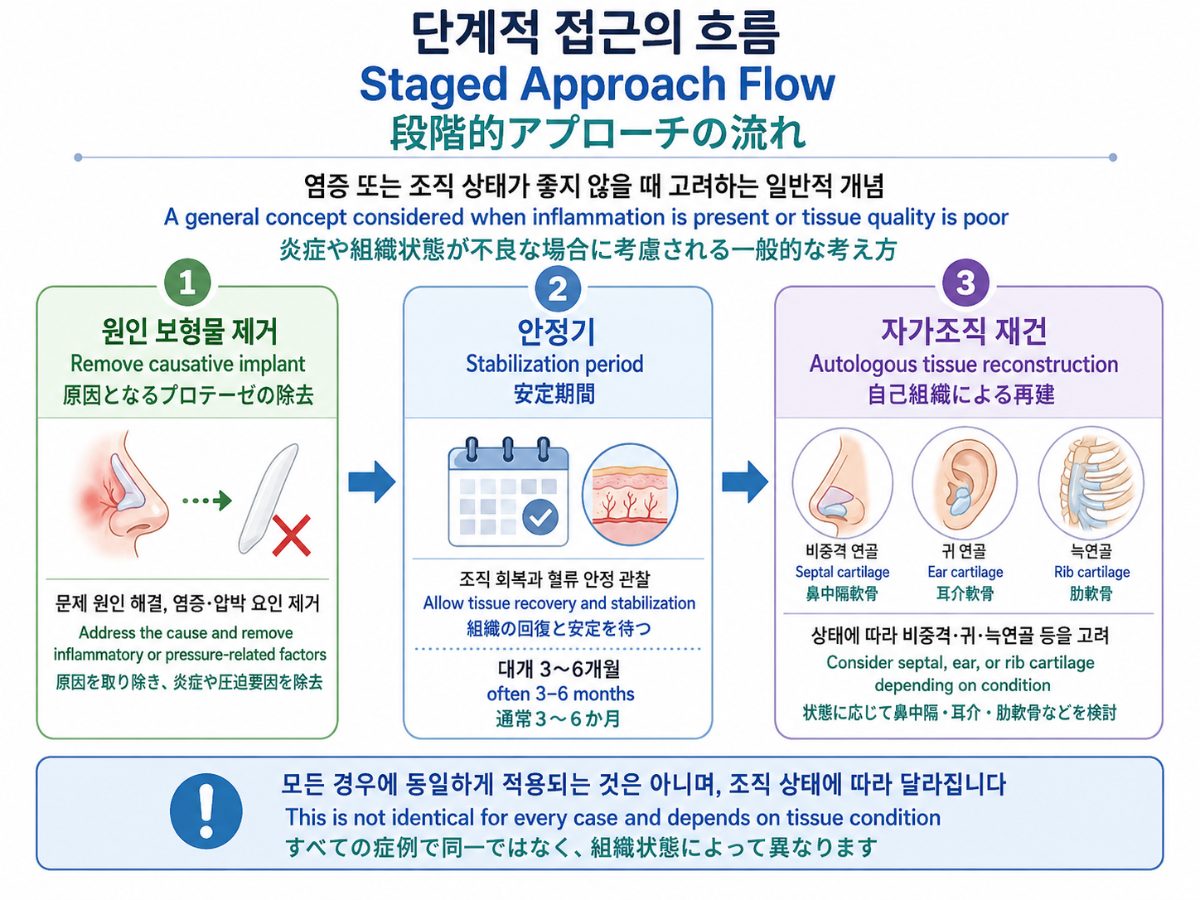
Timing also influences technique and graft selection. When traces of inflammation remain, or the skin and soft-tissue envelope is compromised, a staged approach may be considered: removing the implant and capsule first, allowing roughly 3–6 months for the tissues to stabilize, and reconstructing with autologous tissue thereafter, rather than placing a new implant immediately. Where tissue condition is good and the correction required is limited, septal or conchal cartilage may be sufficient, and costal cartilage is not always necessary.
Summary
- Revision rhinoplasty is generally planned from 6–12 months after the primary surgery (varies by individual).
- Infection, threatened implant exposure, haematoma and significant functional obstruction may warrant assessment regardless of the interval.
- Between 3 and 6 months, the priority is distinguishing residual swelling from a structural deformity.
- Because the staged approach and material selection depend on tissue condition, timing should be determined through in-person examination and individual assessment.
Frequently Asked Questions
Q. Is there any point in a consultation before six months have passed?
A. Yes. Even if no operative date is set, establishing whether the current findings call for observation or early intervention is itself a valid reason for assessment.
Q. If swelling is slow to resolve, should revision be delayed as well?
A. Thicker skin or an extensive primary operation can slow resolution, and more time may be needed before the final contour can be judged. This is a tendency rather than a rule, and varies by individual.
Q. Do the same intervals apply after multiple previous operations?
A. As the number of prior operations increases, scarring and perfusion differ, so assessment of tissue condition carries more weight than the interval alone. A longer waiting period is sometimes advised based on examination and imaging.
Q. Is there anything to manage while waiting?
A. Avoiding smoking, protecting the nose from pressure and trauma, and seeking assessment promptly if signs of inflammation appear are all helpful. Recommendations on self-massage or medication vary with individual findings and should be confirmed at consultation.
Related columns
- How is late-onset contracture after rhinoplasty approached?
- Why does the nasal tip feel firm after rhinoplasty?
- Why does an implant show through thin nasal skin?
- How do conchal and septal cartilage differ in rhinoplasty?
Sources
- Korean Society of Plastic and Reconstructive Surgeons, *Standard Textbook of Plastic Surgery* — chapters on rhinoplasty and revision rhinoplasty
- Gunter JP, Rohrich RJ, Adams WP, *Dallas Rhinoplasty: Nasal Surgery by the Masters* — chapters on timing and tissue assessment in revision rhinoplasty
- Korean Society of Otorhinolaryngology, *Otorhinolaryngology* — chapters on the septum, nasal valve and nasal obstruction
Author · Reviewer · Dates
- Author: Dr. Kim Ji-hun, Board-Certified Plastic Surgeon
- Reviewed by: [Reviewer Name]- Published: 2026-09-02 / Last updated: 2026-09-02
※ This column is provided for general medical information and does not replace diagnosis or treatment for an individual patient. Indications, recovery and possible complications vary by individual, and accurate assessment requires in-person examination by a specialist.