Why Does My Nose Look Crooked After Rhinoplasty?

Why Does My Nose Look Crooked After Rhinoplasty?
Key answer
The most common reason a nose looks crooked early after surgery is uneven swelling between the two sides, which can change over weeks to months. Other possibilities include a septal deviation or bony or facial asymmetry that was present before surgery and becomes more visible afterward, and a change in the position or shape of an implant or cartilage graft. Because the approach differs by cause, timing and clinical findings are evaluated together (varies by individual).
1. What can make a nose look crooked after surgery?
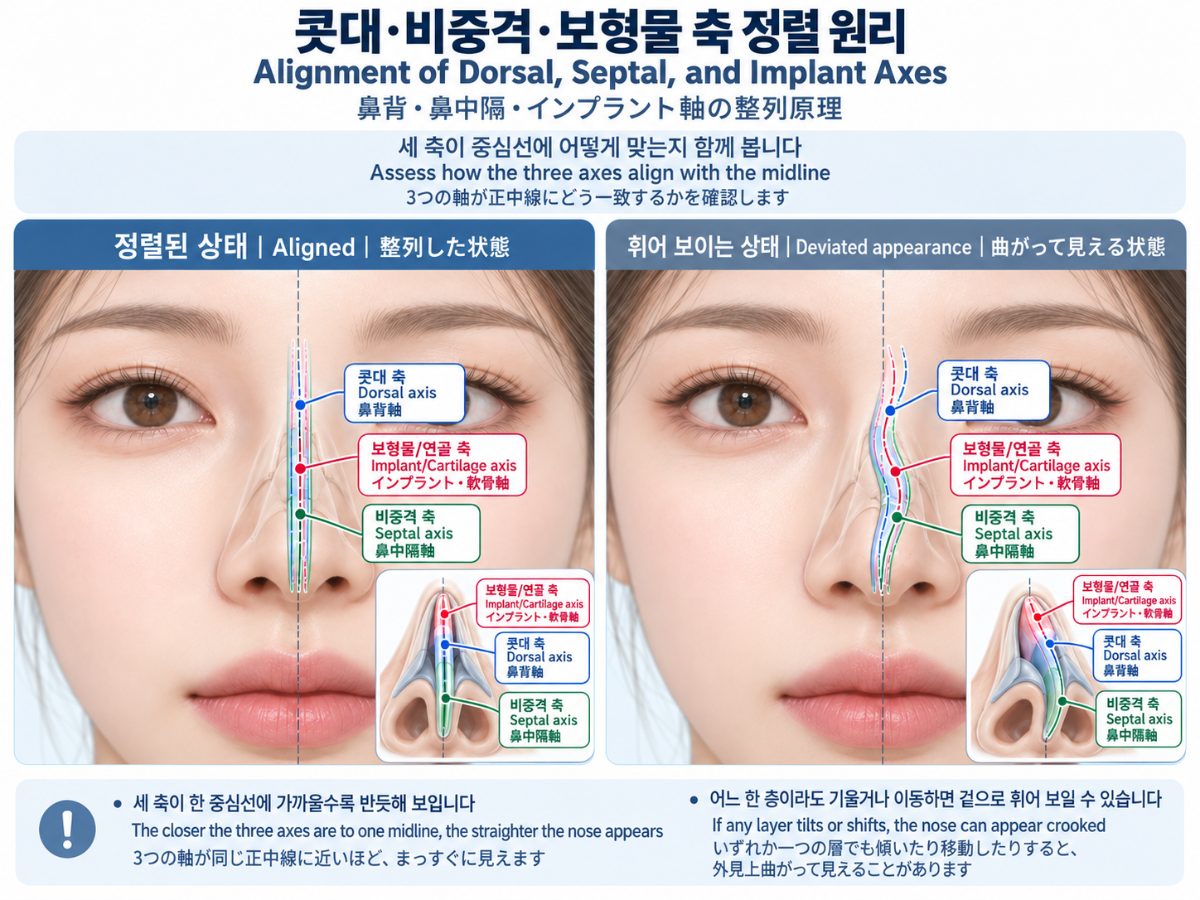
The midline of the nose is formed by the dorsum (bone and cartilage), the septum, the tip structures, and the skin and soft tissue. Asymmetry in any one layer can appear as a visible deviation.
| Cause | Typical timing | Features | General approach |
|---|---|---|---|
| Uneven swelling | Weeks to months after surgery | Appearance varies by time of day or sleeping position; soft on palpation | Observation |
| Pre-existing septal or bony asymmetry | Becomes clearer as swelling settles | May come with differences in nostril size or airflow | Internal assessment, then correction considered if needed |
| Implant shift or tilt | Can occur months later | A directional edge felt along the dorsum | Palpation and imaging, then judgment |
| Change in graft shape (warping) | Months or later | Gradual lean to one side | Confirm whether it is progressing, then judge |
| Uneven capsule or adhesion | Months later | One side feels firmer or tighter | Differentiate, then decide |
| Trauma or repeated pressure | Any time | Change after a specific event | History; imaging if needed |
2. How do we tell swelling from a structural problem?
Several points are reviewed together in the clinic.
1. Change over time: If the deviation looks different between morning and evening or with sleeping position, swelling may play a larger role. If it stays constant in direction and degree, a structural cause is considered more likely.
2. Palpation: We check whether the edge of an implant or graft can be felt to one side and whether tissue beneath the skin is firm.
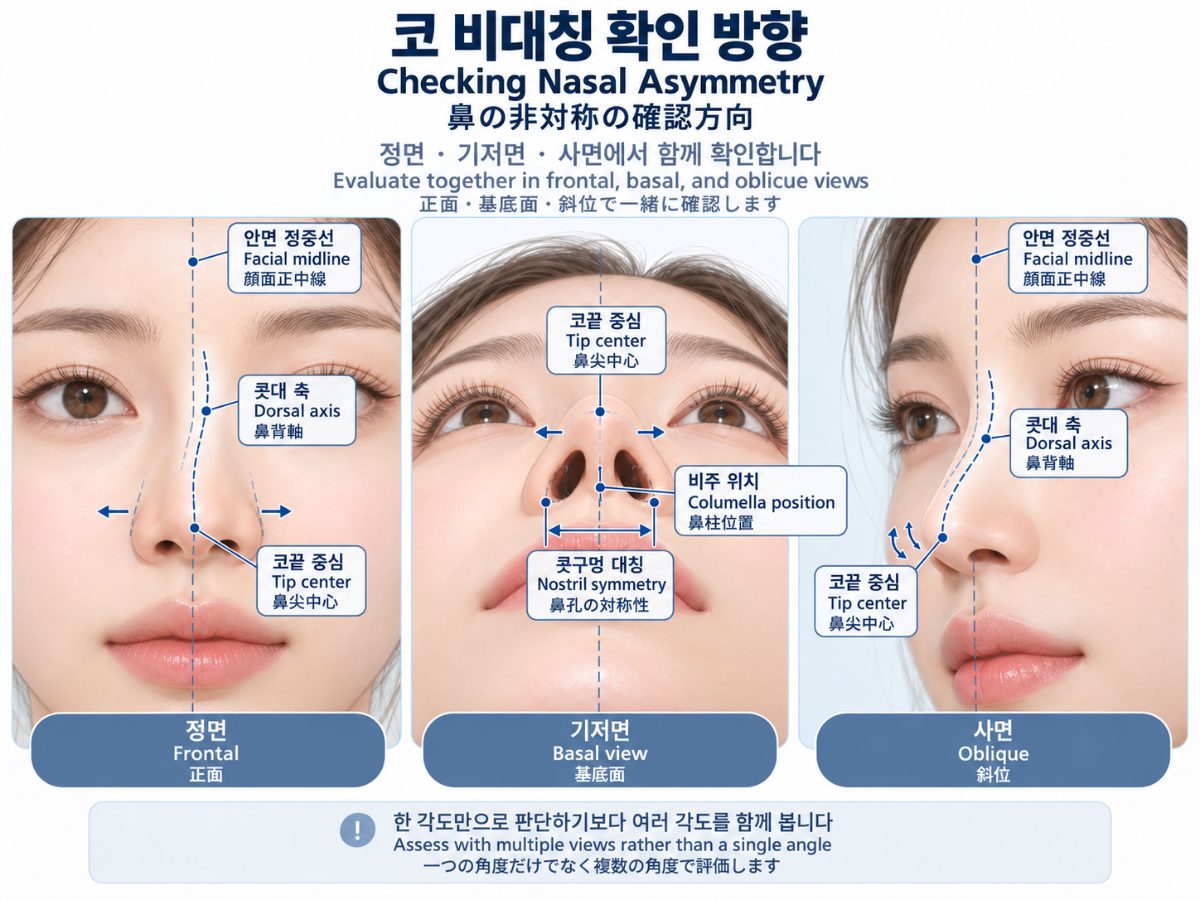
3. Multiple viewing angles: Front, base (from below), oblique views and the nose during facial expression are all observed; a single photo angle is rarely enough.
4. Nostril and septum assessment: Nostril shape, degree of septal deviation and airflow are checked.
5. Underlying facial asymmetry: A tilt in the eyes, mouth corners or jawline can make nasal deviation look larger.
Nasal endoscopy is considered when the septum needs direct inspection, and CT when the bony and septal structure or the area around an implant must be reviewed. Neither is needed in every case.
3. How long is observation reasonable, and when is revision considered?
The first weeks to months are a period when swelling is still settling, so judgments in this period may be provisional. Much nasal swelling subsides within a few weeks, but subtle swelling can persist for months and, in some cases, close to a year (varies by individual). A left–right difference in this period is therefore often observed first.
Earlier evaluation is advisable if:
- the deviation does not lessen and becomes more evident over time,
- it comes with one-sided blockage, pain, swelling or redness, or
- it changes suddenly after an impact to the nose.
Whether a revision is worth considering depends on the cause, whether the nose has stabilized, and whether there is a functional problem. General criteria for revision timing are covered in a related column.
Material considerations — Grafted cartilage can change shape over time, so when cartilage is used, the type of cartilage and how it is shaped and fixed are considered together. This is a case-by-case decision and does not mean any one material is superior.
Summary
- A nose that looks crooked after surgery has several possible causes: swelling, pre-existing asymmetry, and implant or cartilage changes.
- Early left–right differences may be swelling, but persistence, progression or symptoms call for evaluation.
- Examination, palpation and multi-angle assessment, with nasal endoscopy or CT when needed, help distinguish the cause.
- Individual variation is substantial, so an in-person assessment is needed.
Frequently Asked Questions
Q1. My nose looks crooked after surgery. Is it just swelling?
A. Early on it may be uneven swelling, and whether the appearance changes over time is one clue. Because individual variation is large, confirmation at an examination is needed.
Q2. Can sleeping on one side bend my nose?
A. In the early recovery period patients are generally advised to avoid pressure on the nose. Pressure may affect the result, so please follow your surgeon's instructions.
Q3. My nose was slightly crooked before surgery and looks more noticeable now. Why?
A. When the shape of the dorsum changes, a pre-existing septal, bony or facial asymmetry can become relatively more visible.
Q4. Is a CT scan always necessary?
A. No. It is considered when the examination suggests that structure needs to be reviewed.
Q5. When should I be seen?
A. Evaluation is advised when the deviation is progressing, when pain, blockage or swelling accompanies it, or when it changes suddenly after an injury.
Related columns
- Why Crooked Nose Correction Takes More Than Straightening the Bridge
- When Can Revision Rhinoplasty Be Considered After the First Surgery?
- Why Does the Nasal Tip Feel Hard After Nose Surgery?
- How Do Ear Cartilage and Septal Cartilage Differ in Rhinoplasty?
Sources
- General principles from Korean Society of Plastic and Reconstructive Surgeons and otolaryngology practice guidance and standard rhinoplasty textbooks (verify any specific citation before publication)
- Standard plastic surgery textbook principles on nasal asymmetry and septal evaluation
Author: Dr. Kim Jihun, Board-Certified Plastic Surgeon, VVLY Plastic Surgery
Published: 2026-09-30 · Last updated: 2026-09-30
※ This column provides general medical information and does not replace diagnosis or treatment for an individual patient. Indications, recovery course and possible complications vary by individual, and an accurate judgment requires an in-person examination and individual assessment by a specialist.