When Is Autologous Rib Cartilage Needed in Revision Rhinoplasty?

# When Is Autologous Rib Cartilage Needed in Revision Rhinoplasty?
In revision rhinoplasty, autologous rib cartilage is not a default material. It is considered when other options cannot provide the structure the nose needs. Typical situations include very little septal cartilage remaining after the first surgery, or a need to substantially rebuild tip support and dorsal structure. When enough cartilage remains and the skin envelope is favorable, rib cartilage may not be necessary (varies by individual).
What role does cartilage play in the nose's supporting structure?
The shape of the nasal tip and bridge is held up by the cartilage framework beneath the skin. Septal cartilage forms the central wall of the nose and acts as a pillar supporting the tip. If much of it was used or harvested in a previous operation, less remains for revision. Part of it, the L-shaped strut that supports the dorsum and tip, must be preserved to maintain structure, so not all remaining cartilage is available for grafting.
How is the choice between rib cartilage and other options made?
The needed structure is defined first, and the material is then chosen to build it.
| Factor | Leans toward rib cartilage | Other material may suffice |
|---|---|---|
| Remaining septal cartilage | Little or none beyond the L-strut | Usable amount remains |
| Support required | Major tip/dorsal reconstruction | Minor reinforcement or contour refinement |
| Skin and soft tissue | Thin or scarred; risk of visible edges or recontracture | Relatively thick, well-vascularized |
| Existing implant | Removal and structural rebuilding needed | Retention or replacement is enough |
| Donor-site acceptance | Patient understands and accepts chest-site pain and scar | Patient prefers to avoid it and an alternative is feasible |
This table illustrates the reasoning; actual choices are made after individual examination and testing.
What is checked at the examination?
1. Amount and condition of remaining septal cartilage: assessed by nasal endoscopy and palpation; CT may be added to evaluate cartilage and any existing implant.
2. Degree of tip support loss: tip recoil on pressure, tip angle, and nostril symmetry.
3. Skin thickness, elasticity, and scarring: thin or firm skin after repeated surgery affects how visible graft edges may become.
4. Type, position, and surrounding condition of any existing implant: this guides the need for removal and the extent of reconstruction.
5. Patient understanding and preference regarding the donor site, including incision and recovery.
What are the limitations and precautions of rib cartilage?
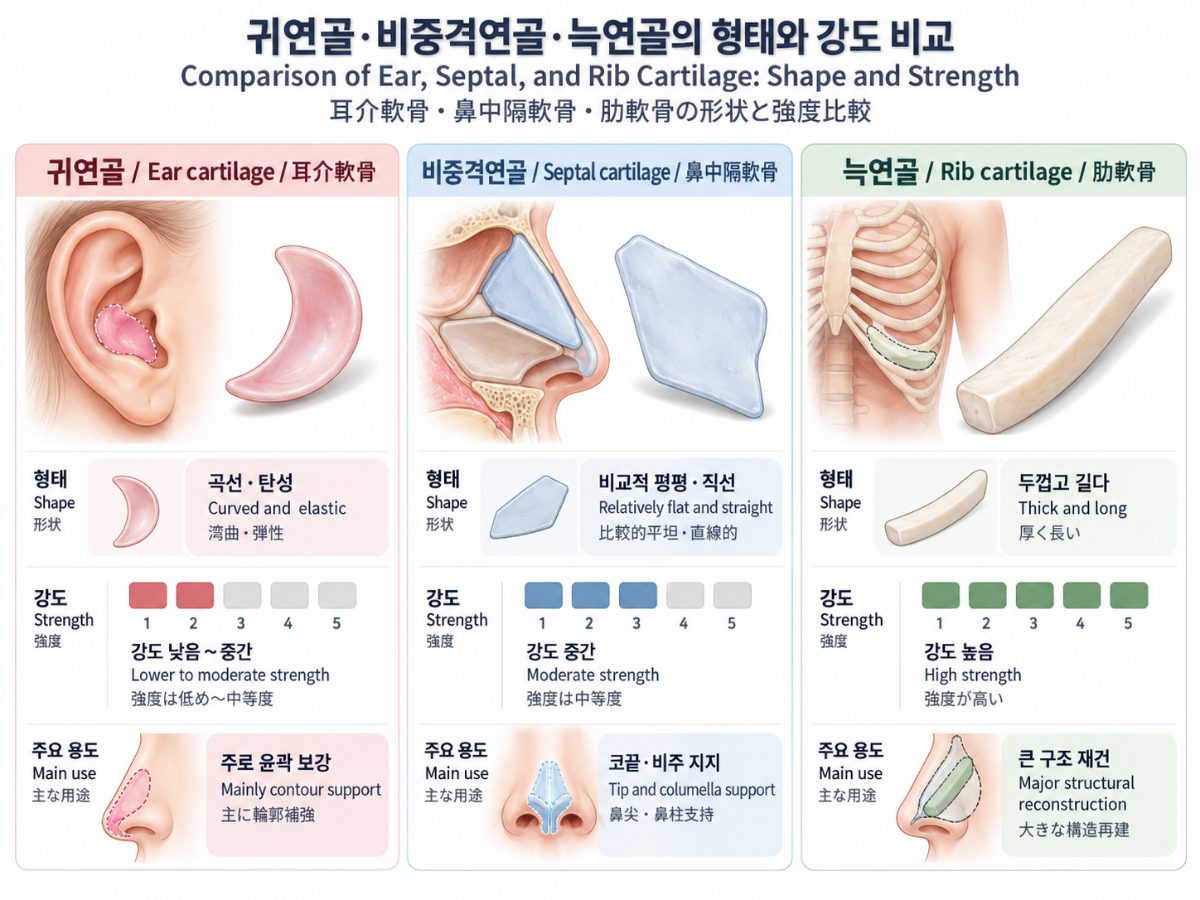
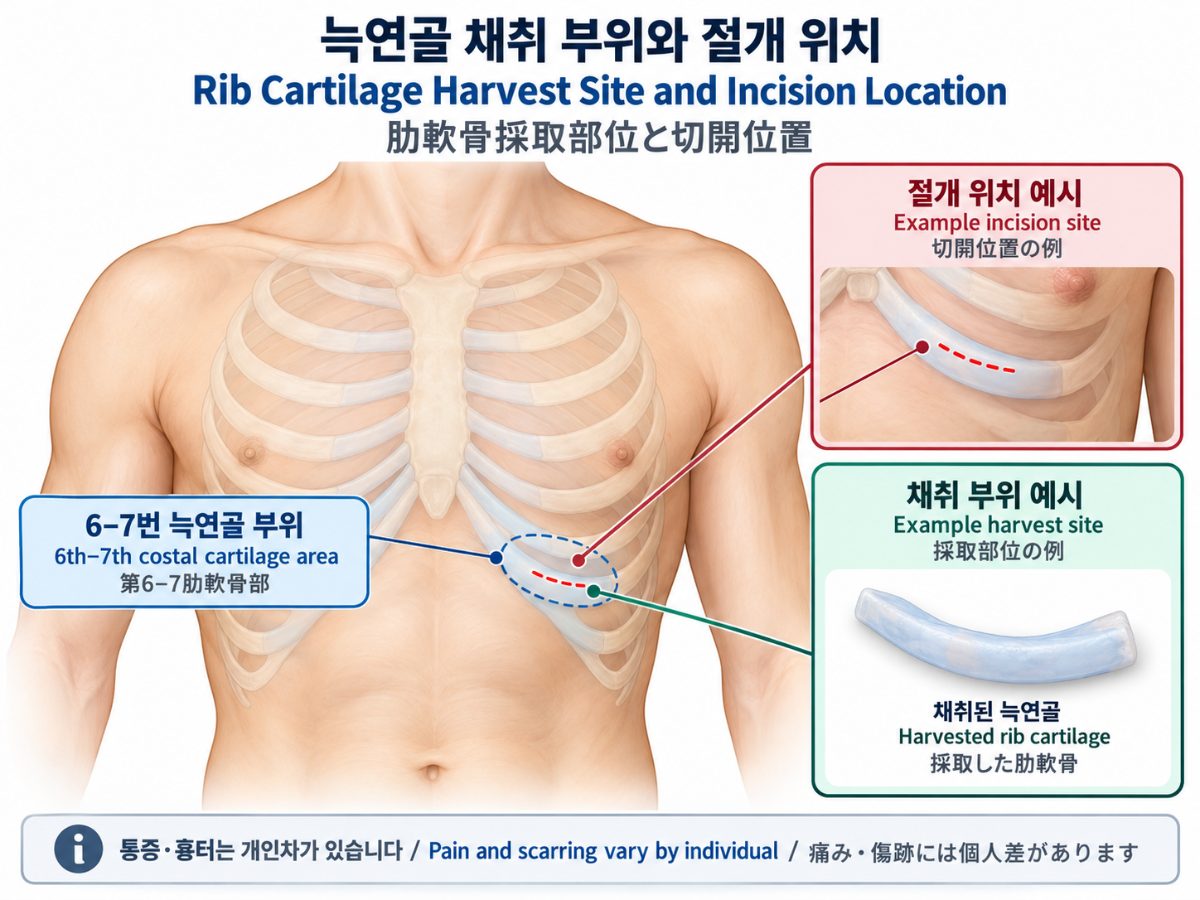
Rib cartilage is abundant and firm, which suits structural reconstruction, but it has drawbacks. Donor-site pain and scarring can occur, and respiratory complications are rarely reported. Rib cartilage also has a tendency to warp over time, so how it is carved and positioned is an important part of planning. Using rib cartilage does not eliminate the possibility of infection or deformity.
How does the decision proceed in practice? (anonymized reasoning)
Consider a patient presenting with an upturned tip and thinned skin after a first surgery. Nasal endoscopy confirms how much septal cartilage remains, and CT helps assess the area around any implant. If usable septal cartilage beyond the L-strut is insufficient and tip support must be rebuilt, rib cartilage becomes a candidate. If support loss is mild and enough cartilage remains, a plan without rib cartilage may be considered. This illustrates a reasoning process, not any particular outcome.
Summary
- Autologous rib cartilage is considered when remaining cartilage is insufficient or major structural rebuilding is needed.
- The needed structure is defined first, with septal reserve, tip support, skin condition, and existing implants evaluated together.
- It has limits, including donor-site pain, scarring, and possible warping, so thorough explanation and consent are essential.
- Suitability varies widely and requires in-person examination and individual assessment by a specialist.
Frequently asked questions
Q1. Does every revision rhinoplasty require rib cartilage?
No. It depends on remaining cartilage and the scale of reconstruction; other materials are sufficient in some cases.
Q2. Will harvesting rib cartilage leave a scar on the chest?
An incision is needed for harvest, so a scar may remain; its location and extent vary by individual.
Q3. Can rib cartilage warp over time?
It can tend to warp. Carving and placement techniques aim to reduce this, but the possibility cannot be eliminated.
Q4. What tests are done beforehand?
Examination and nasal endoscopy form the basis; CT may be added to evaluate cartilage and any existing implant.
Q5. Is ear cartilage not enough?
Ear cartilage is curved and elastic, which can limit its use as a load-bearing support. See the related columns below for details.
Related columns
- When Can Revision Rhinoplasty Be Considered After the First Surgery?
- Rib Cartilage in Rhinoplasty — Autologous vs. Donor Cartilage
- How Do Ear Cartilage and Septal Cartilage Differ in Rhinoplasty?
- Why Does a Nasal Implant Show Through Thin Nose Skin?
Sources
- Korean Society of Plastic and Reconstructive Surgeons, textbook "Plastic Surgery" (chapters on rhinoplasty and cartilage grafting)
- Gunter JP et al., eds., "Dallas Rhinoplasty: Nasal Surgery by the Masters" (chapters on revision surgery and cartilage grafting)
- Daniel RK, "Mastering Rhinoplasty" (chapters on cartilage grafts and structural reconstruction)
These are listed at reference-book level; individual figures vary by patient.
Author · Reviewer · Dates
Author: Dr. Jihun Kim, Board-Certified Plastic Surgeon, VVLY Plastic Surgery Clinic
Published: 2026-10-14 · Last updated: 2026-10-14
* This column provides general medical information and does not replace diagnosis or treatment for an individual patient. Indications, recovery, and possible complications vary by person, and an in-person examination and individual assessment by a specialist are required.