If I Have Nasal Congestion, Should Septal Surgery Be Done Together with Rhinoplasty?

Nasal congestion does not automatically mean septal surgery is needed. Besides a deviated septum, obstruction can stem from inferior turbinate enlargement, nasal valve narrowing, or allergic rhinitis — and depending on the cause, surgery may be unnecessary or medical treatment may come first. When a structural cause is confirmed and the patient also wishes to change the shape of the nose, rhinoplasty and septal or turbinate surgery can be planned as a single procedure. In that case, the airway and the nose's support framework are evaluated before appearance (individual results vary).
Where in the Nose Does Obstruction Occur?
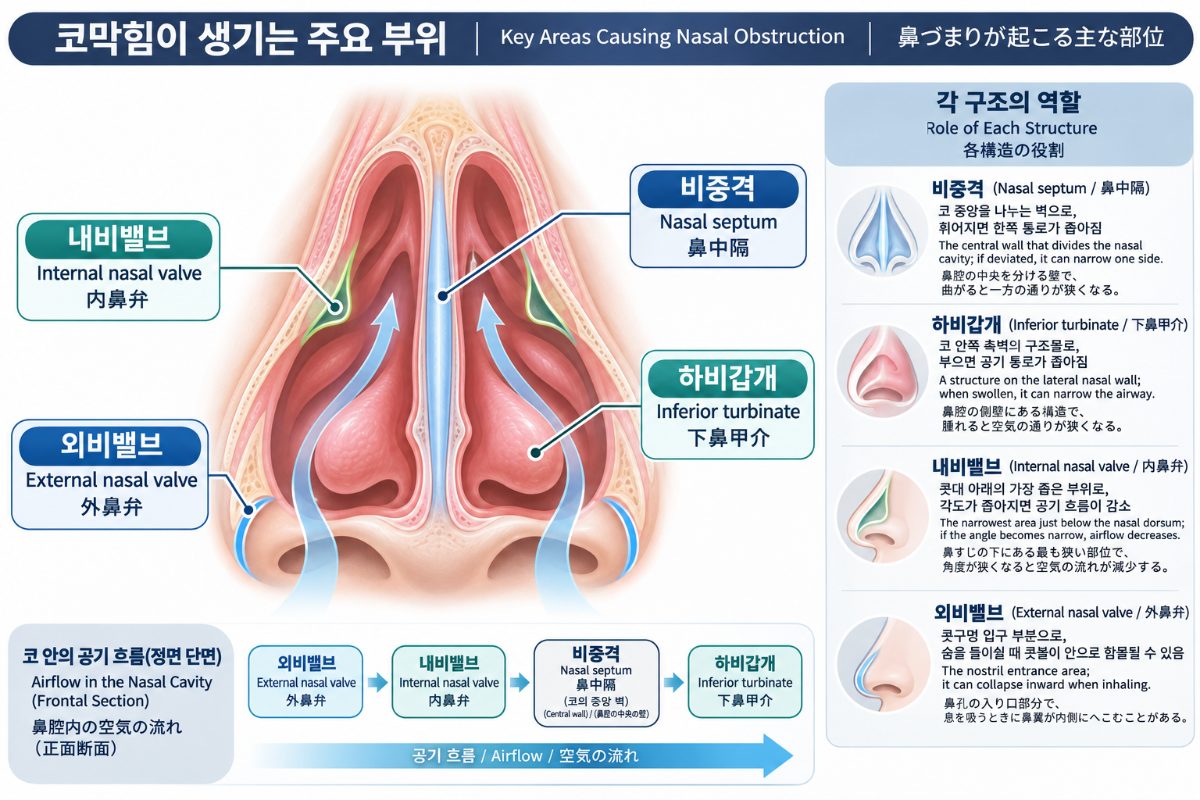
The nasal airway is shaped by the septum (the central wall), the turbinates projecting from the side walls, and the nasal valve, the narrowest entry point just inside the nostril. Narrowing at any of these sites can cause a sense of blockage.
- Septal deviation: the septal cartilage or bone bends to one side, narrowing one passage. It may result from injury or growth and can accompany an externally crooked nose.
- Inferior turbinate hypertrophy: swollen turbinate lining or enlarged turbinate bone obstructs the airway, often together with rhinitis.
- Internal nasal valve narrowing: the angle between the upper lateral cartilages and the septum becomes narrow. This can matter when cartilage support weakens after hump reduction, or when the middle vault is naturally narrow.
- External nasal valve collapse: the nostril walls are drawn inward on inhalation, typically when alar cartilage support is weak.
Because each cause calls for a different solution, anyone with congestion who is considering rhinoplasty should first find out where the blockage is.
What Is Checked During the Examination?
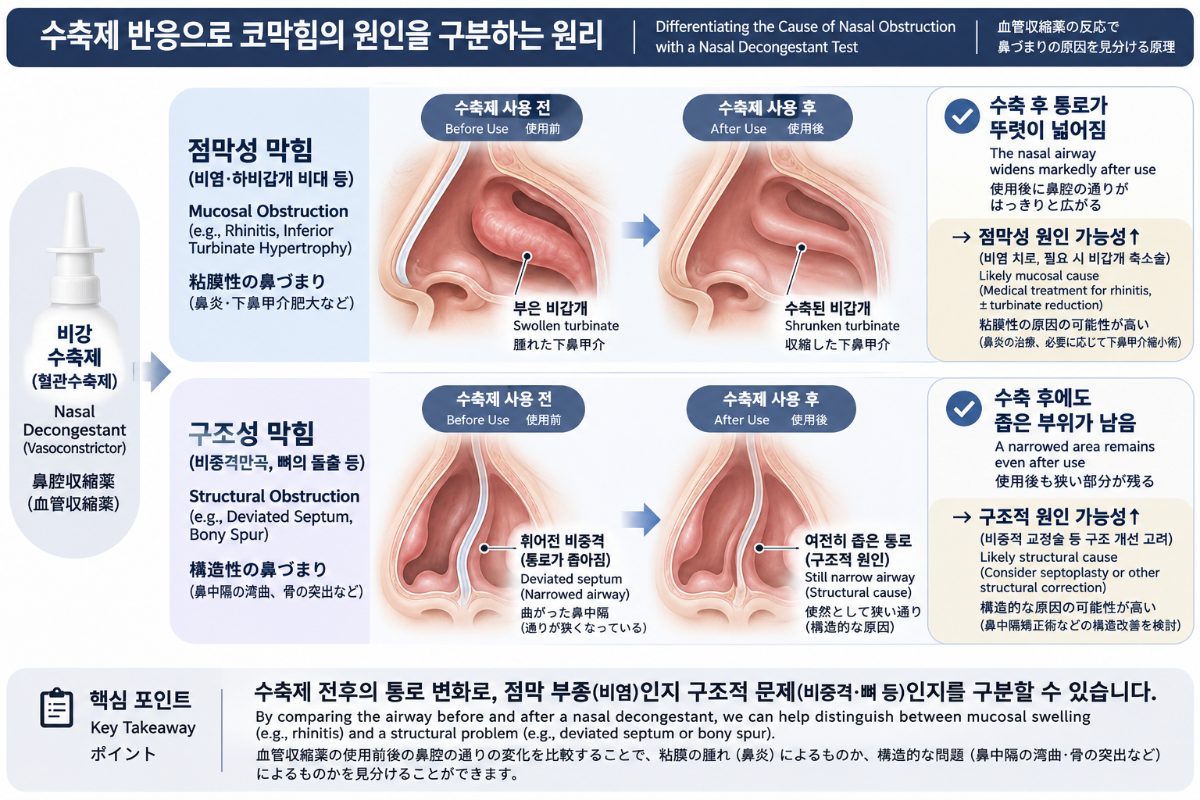
In clinical practice, the following points are assessed together to narrow down the cause.
1. Symptom pattern: whether one side is constantly blocked, whether the sides alternate, and whether it changes with season or posture. Alternating blockage with runny nose or sneezing points more toward a mucosal (rhinitis) cause.
2. Anterior rhinoscopy and decongestant response: the airway is compared before and after a vasoconstrictor spray. Marked widening suggests mucosal swelling plays a large role; a persistent narrow segment suggests a structural cause such as the septum or bone.
3. Nasal valve assessment: we check whether breathing improves when the cheek is gently pulled outward (Cottle maneuver) or the valve area is lightly supported. If it does, valve narrowing or alar collapse is evaluated further.
4. Nasal endoscopy: used to see posterior septal deviation, turbinate condition, or polyps that are hard to view directly.
5. CT scan: considered when posterior or bony deviation is significant, sinusitis is suspected, or the internal structure must be clarified in revision cases.
This process helps separate congestion that needs septal surgery from congestion that may be managed with medication or turbinate treatment.
| Septal deviation (structural) | Turbinate enlargement / rhinitis (mucosal) | Nasal valve narrowing / collapse | |
|---|---|---|---|
| Pattern | Usually one side, persistently | Alternating sides; varies with season or posture | Worse with deep inhalation |
| Decongestant response | Narrow segment remains | Airway clearly widens | Often little change |
| Associated findings | Crooked nose, history of nasal injury | Runny nose, sneezing, itching | Nostril walls collapse inward; prior hump reduction |
| First approach considered | Septoplasty | Medication → turbinate reduction if response is insufficient | Structural support, e.g., spreader grafts or alar reinforcement |
Note: Several causes often coexist, so this table is only a starting point — individual examination is required.
When Is Combining the Surgeries Considered?
Rhinoplasty and septal surgery are usually planned together when:
- A structural septal deviation is confirmed and the resulting congestion affects daily life
- The external nose is crooked because of the septum, making shape correction difficult without straightening it
- Septal cartilage is planned as graft material for tip work, allowing the deviated portion to be corrected at the same time
- Hump reduction may narrow the middle vault, so valve support needs to be planned in advance
On the other hand, combined surgery is not rushed when:
- The blockage mainly reflects rhinitis or mucosal swelling, and the response to medication should be checked first
- A deviation is visible on imaging but correlates poorly with symptoms
- Septal cartilage was already used extensively in a previous operation, leaving little margin to alter the support framework
What Is Considered When the Surgeries Are Combined?
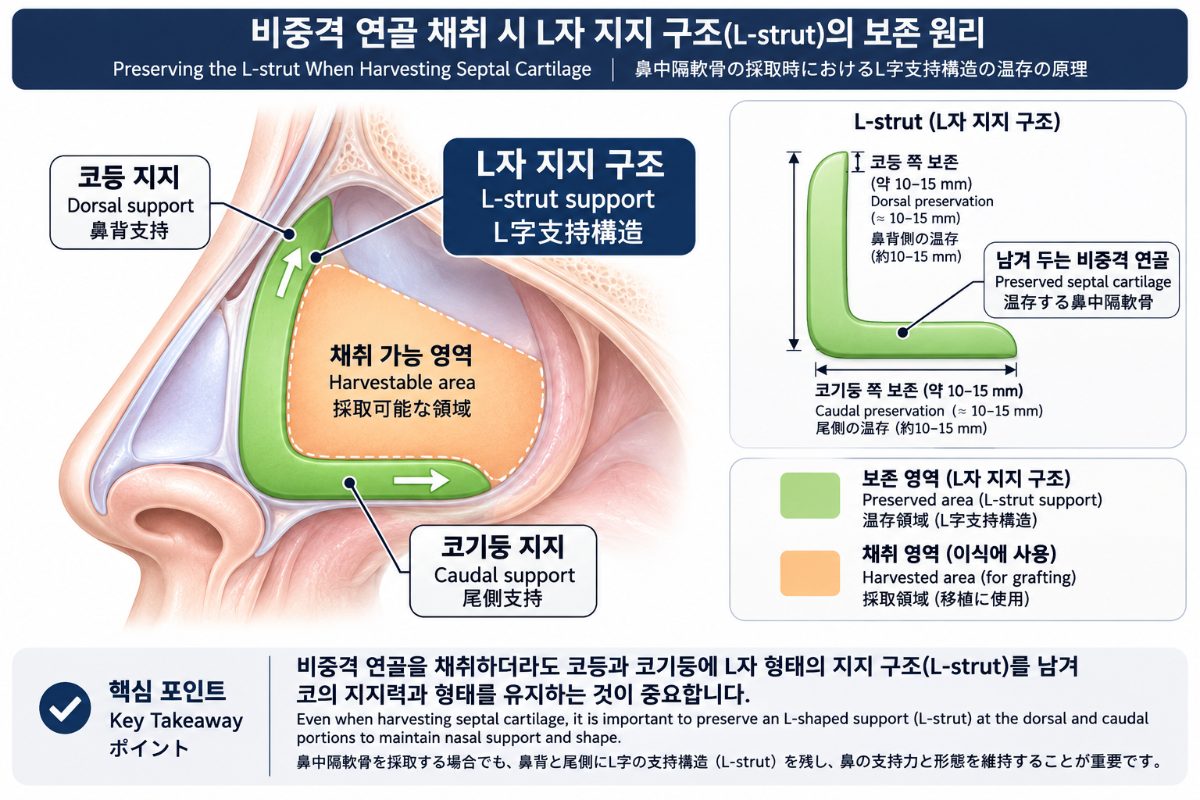
Because the septum also acts as a pillar supporting the tip and bridge, combined surgery balances functional improvement with structural support.
- Preserving support: when septal cartilage is straightened or harvested, an L-shaped strut of adequate width is preserved along the dorsum and columella. If it weakens, the bridge may sag or the tip may droop.
- Graft planning: septal cartilage is a common autologous material for tip surgery, but the available amount varies. When it is insufficient, ear or rib cartilage may be considered.
- Valve support: when a dorsal hump is lowered, the middle vault can narrow, so techniques such as spreader grafts may be planned to keep the airway open.
- Recovery: with added septal surgery, internal splints or packing may stay for a few days, so nasal breathing can feel more restricted early on. Internal splints are usually removed around 5–7 days after surgery, and mucosal healing and crust clearance may take several weeks (individual results vary).
- Limitations and risks: some congestion may persist after surgery, and rhinitis symptoms may recur seasonally. Septal perforation, bleeding, or deformity from weakened support can occur in rare cases, so thorough explanation and evaluation are needed beforehand.
How the Decision Is Made in Practice (Anonymized Example)
Consider a patient who wants tip refinement and reports that the right side is always blocked. If the right passage stays narrow after decongestant and endoscopy shows deviation continuing into the posterior septum, the cause is regarded as structural and septal correction is planned together. The septal cartilage obtained during correction can be used for tip support, while the L-strut is designed to remain sufficient. Conversely, if the airway widens clearly after decongestant and the blockage alternates sides, it is more reasonable to check the response to rhinitis treatment first before planning rhinoplasty.
Summary
- Nasal congestion has various causes — septal deviation, turbinate enlargement, nasal valve problems, rhinitis — and each requires a different approach.
- Decongestant response, valve assessment, endoscopy, and CT when needed help distinguish structural from mucosal causes.
- When a structural cause is confirmed, rhinoplasty can be combined with septal or turbinate surgery, with careful preservation of support.
- Whether surgery is needed, and its extent, should be decided by individual assessment of symptoms and findings.
Frequently Asked Questions (FAQ)
Q1. Does a deviated septum always need surgery?
A. No. Some degree of septal deviation is common. Surgery is considered when it is related to congestion that interferes with daily life. If symptoms are absent or mild, observation may be appropriate.
Q2. Does combining rhinoplasty and septal surgery prolong recovery?
A. External swelling follows a similar course, but internal splints or packing may make nasal breathing more uncomfortable for the first few days. The nasal lining may take several weeks to settle, and this varies by individual.
Q3. Can septal surgery change the shape of my nose?
A. Septoplasty itself corrects the internal airway, but because the septum supports the tip and bridge, inadequate preservation of support can alter the shape. Conversely, when a crooked nose originates from the septum, correction can help the external appearance.
Q4. Can I have rhinoplasty if I have rhinitis?
A. Often yes, but congestion caused by rhinitis may not be resolved by rhinoplasty or septal surgery alone. When symptoms are significant, the response to medication is usually checked before surgery is planned.
Q5. Is a CT scan always required before rhinoplasty?
A. Not always. It is decided based on examination findings — for example, significant posterior deviation, suspected sinus disease, or revision cases requiring a clear view of internal structures.
Related Columns
- When Is a CT Scan or Nasal Endoscopy Needed Before Revision Rhinoplasty?
- Correcting a Crooked Nose: Why Building Up the Bridge Alone Isn't Enough
- Ear Cartilage vs. Septal Cartilage: How Do They Differ in Rhinoplasty?
- Hump Nose Correction — Why Shaving It Down Isn't the Whole Story
Sources
- American Academy of Otolaryngology–Head and Neck Surgery Foundation, Clinical Practice Guideline: Improving Nasal Form and Function after Rhinoplasty
- American Academy of Otolaryngology–Head and Neck Surgery, Clinical Consensus Statement: Septoplasty with or without Inferior Turbinate Reduction
- Cummings Otolaryngology: Head and Neck Surgery (chapters on septal, turbinate, and nasal valve anatomy and surgery)
- Academic materials of the Korean Society of Plastic and Reconstructive Surgeons and the Korean Rhinologic Society
Author · Reviewer · Dates
- Author: Dr. Jihun Kim, Board-Certified Plastic Surgeon (Representative Director, VVLY Plastic Surgery)
- Reviewed by: [Reviewer Name - Published: 2026-11-11 · Last updated: 2026-11-11
This column provides general medical information and does not replace diagnosis or treatment for any individual patient. Indications, recovery, and possible side effects of surgery or procedures vary from person to person; an in-person consultation and individual assessment by a specialist are necessary for an accurate judgment.