Can the Nasal Tip Droop Over Time After Rhinoplasty?

Can the Nasal Tip Droop Over Time After Rhinoplasty?
Key Answer
After rhinoplasty, the nasal tip may settle slightly over several months to about a year, and this is often part of the normal process of swelling resolution and soft-tissue contraction. However, if tip support was not sufficiently reconstructed, if a cartilage graft bends or partially resorbs, or if thick skin places a heavier load on the tip, a more noticeable droop can result. Rather than deciding on revision from the impression of "drooping" alone, it is important to assess the time since surgery, tip recoil, and any change on smiling to distinguish normal settling from weakened support (individual results vary).
What holds the nasal tip up?
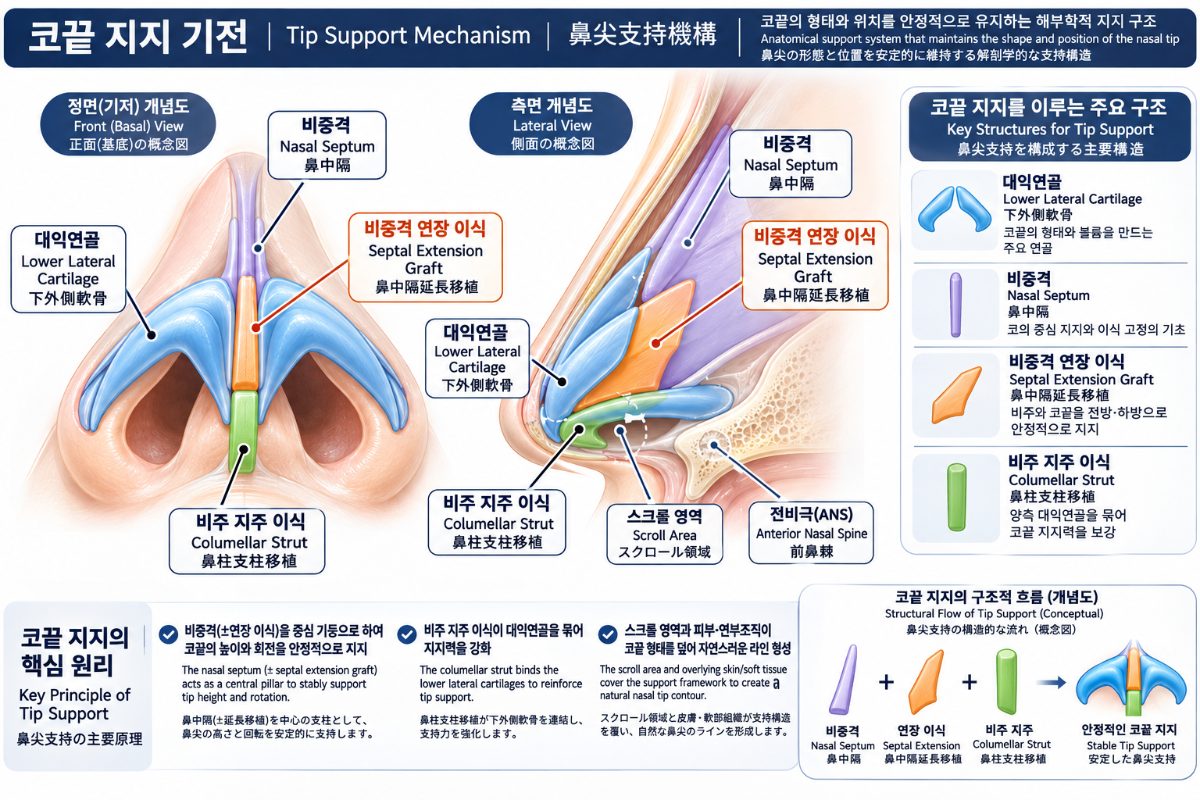
Tip projection and rotation are maintained not by a single cartilage but by several structures working together. Rhinoplasty textbooks describe these as "tip support mechanisms," divided into major and minor elements.
- Major support: the size and strength of the lower lateral (alar) cartilages, the attachment of the medial crura to the caudal septum, and the connection between the upper and lower lateral cartilages at the scroll area
- Minor support: the interdomal ligament, the dorsal septum, the anterior nasal spine, and the elasticity of the skin and soft-tissue envelope
In open rhinoplasty, some of these attachments are released for exposure, so support is rebuilt during surgery using techniques such as a columellar strut or a septal extension graft. How firmly and stably that reconstruction is fixed influences the long-term position of the tip.
Why does the tip come down over time?
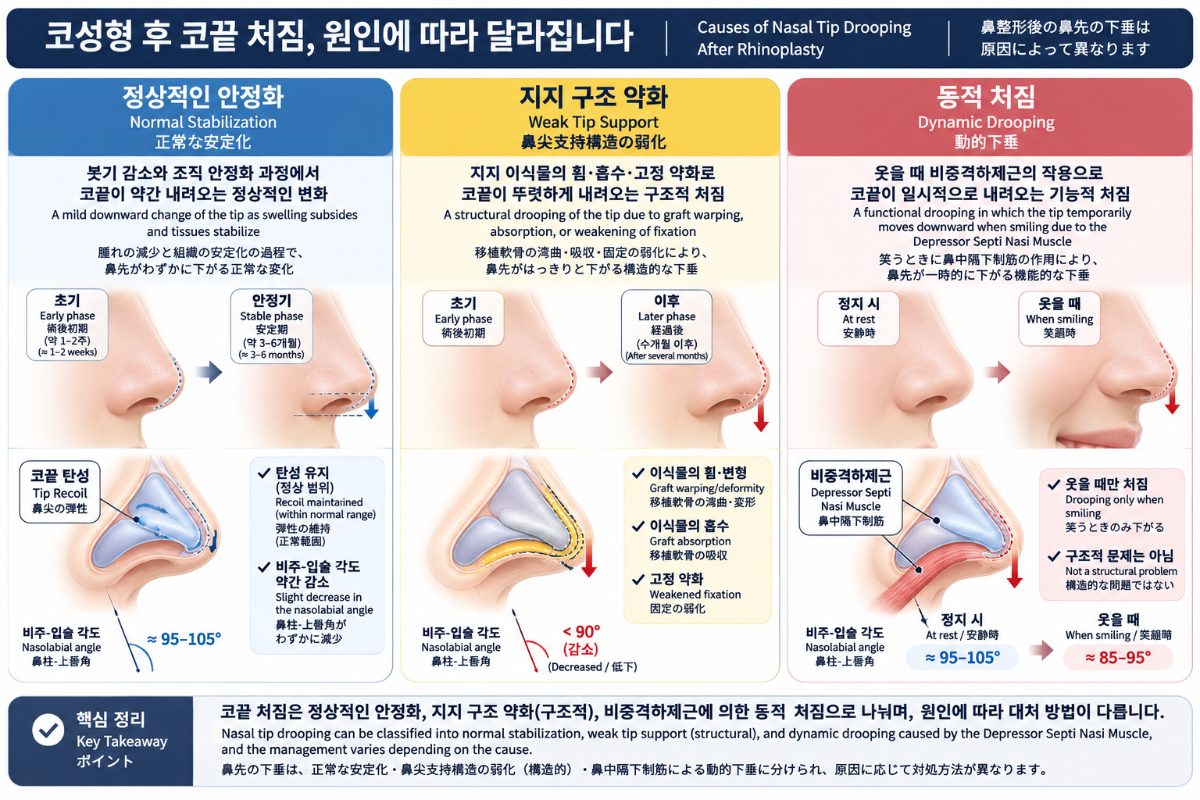
Changes in tip position are interpreted differently depending on when they appear and how they look. The table below summarizes patterns commonly distinguished in clinical practice.
| Pattern | Typical timing | Features | General interpretation |
|---|---|---|---|
| Swelling resolution / tissue settling | 1–6 months | Tip lowers slightly and definition improves; recoil preserved | Usually a normal course |
| Soft-tissue contraction / scar remodeling | 6–12 months | Subtle angle change, symmetry maintained | Observation first |
| Bending, resorption, or loosening of support grafts | Months to years | Reduced tip recoil; columella looks short or tilts to one side | Support needs reassessment |
| Load from thick skin | Months to years | Tip definition blunts and descends gradually | Plan must account for skin character |
| Dynamic droop only on smiling | May exist before surgery | Normal at rest; tip descends and upper lip shortens on smiling | Evaluate muscle action (depressor septi nasi) |
Note that a contracted nose usually behaves differently: inflammation or scarring tightens the tissues so the tip is pulled upward and becomes firm. Because the direction and cause differ from drooping, the two need to be distinguished.
What is checked during examination?
When a patient feels the tip has dropped, the following points are assessed together to narrow down the cause.
1. Time since surgery: before about six months, residual swelling still affects shape, so it is too early to judge the final position.
2. Tip recoil: if the tip springs back weakly after gentle pressure, weakened support is suspected.
3. Nasolabial angle: comparing with pre- and early postoperative records helps separate a true angle change from a perceived one.
4. Change on smiling: if the tip descends and the upper lip shortens only when smiling, dynamic action of the depressor septi nasi is considered.
5. Palpation and intranasal exam: graft position and bending, columellar tilt, and the amount and condition of remaining septum are checked. If septal cartilage was harvested previously or its condition is unclear, CT or nasal endoscopy may be used to evaluate internal structures before planning.
Example of clinical reasoning (a generalized, hypothetical scenario — not a specific patient)
If a patient reports the tip seems lower one year after surgery, a clearly reduced resting nasolabial angle compared with early postoperative records, combined with weak recoil, points toward weakened support. If the resting angle is preserved and the tip drops only on smiling, muscle action is evaluated before structure. In the former case, if most septal cartilage was used in the first operation, the next step is to confirm the remaining amount with imaging and consider other cartilage sources.
If correction is needed, which materials are considered?
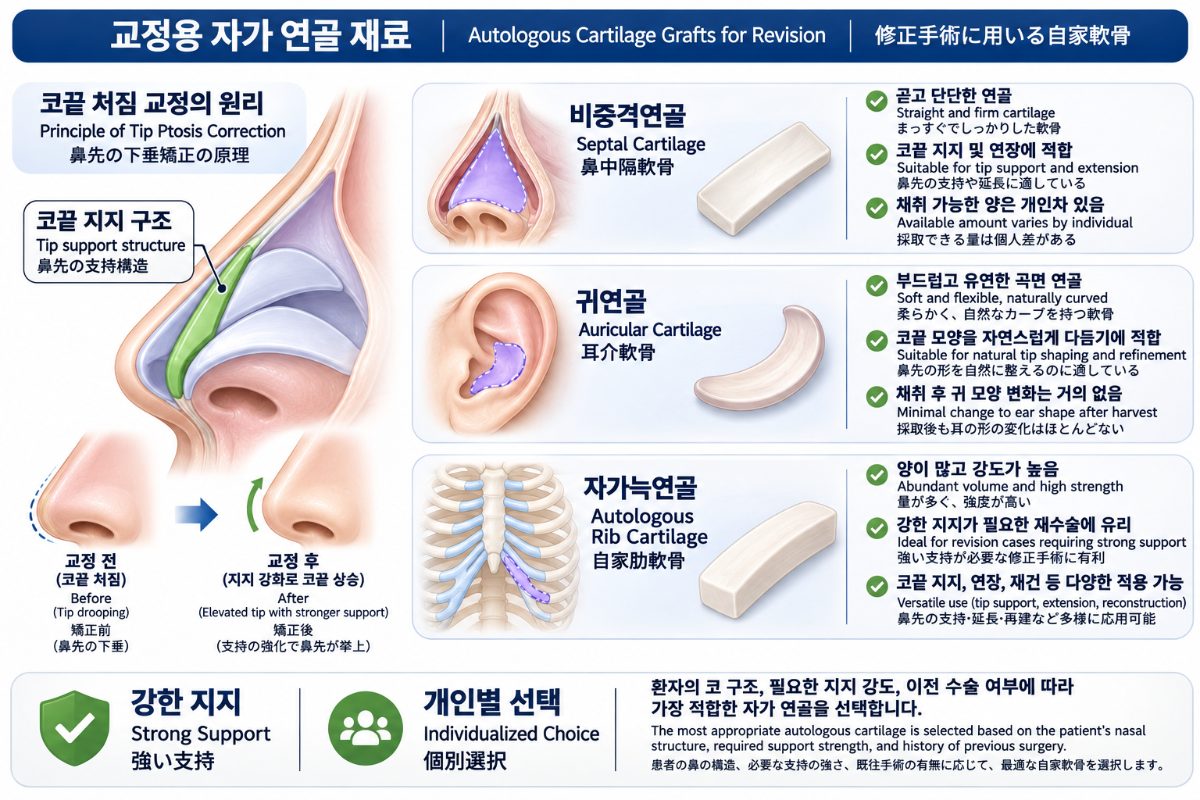
When the droop is attributed to weakened support and correction is warranted functionally or aesthetically, a material is chosen to re-support the tip. Revision is generally considered only after tissues have adequately stabilized—typically 6–12 months or more after the first surgery, depending on the individual.
| Material | Characteristics | When it is considered | When more caution is needed |
|---|---|---|---|
| Septal cartilage | Straight and relatively firm | Enough septum remains with little warping | Already harvested previously, or septum is weak |
| Ear cartilage | Soft and naturally curved | Refining tip shape, supplementary support | Strong standalone support (extension, fixation) is required |
| Autologous rib cartilage | Abundant and strong | Septum depleted, multiple revisions, strong support needed | Mild droop not requiring major reconstruction; donor-site burden on the chest must be weighed |
If the droop is mild and the resting angle is maintained, observation is often more appropriate than surgery. When dynamic droop on smiling is the main concern, muscle action needs separate assessment, and both the approach and the expected range vary by individual. With thick skin, changes in tip definition may be limited even after support is reinforced, which should be considered in advance. Revision surgery involves more scar tissue than a primary operation, so recovery may take longer and further adjustment is sometimes needed.
Summary
- Slight lowering of the tip after rhinoplasty commonly occurs as swelling resolves and tissues settle.
- A distinct droop with reduced recoil over months to years may suggest bending, resorption, or loosening of support grafts.
- It should be distinguished from a contracted nose, which pulls the tip upward, and from dynamic droop that appears only on smiling.
- Whether and how to correct it depends on remaining cartilage, skin thickness, and degree of droop, so an in-person examination and individual assessment by a specialist are needed.
Frequently Asked Questions (FAQ)
Q1. It has been three months and my tip seems lower. Should I consider revision?
A. Around three months, tip shape and height are still changing as swelling resolves, so it is too early to judge the final position. Unless there are concerning signs such as pain, redness, or progressive asymmetry, the result is usually assessed over 6–12 months (individual results vary).
Q2. How is tip droop different from a contracted nose?
A. Droop is a downward change caused by weakened support, whereas a contracted nose often involves inflammation or scarring that pulls the tip upward and makes it firm. Because direction and cause differ, recoil, skin condition, and course are examined together.
Q3. If the tip goes down only when I smile, is that drooping?
A. If the tip position is stable at rest and descends only on smiling, the action of the muscle that pulls the tip downward (depressor septi nasi) is evaluated first, rather than the cartilage framework. The approach may differ from that for structural droop.
Q4. Can ear cartilage alone reinforce tip support?
A. Ear cartilage is soft and curved, which makes it useful for refining tip shape, but it may not provide enough support on its own when strong support or lengthening is needed. Depending on the remaining septal cartilage and the support required, septal or rib cartilage may also be considered.
Related Columns
- When the Nose Looks Long, Is Lifting the Tip Enough?
- When Can Revision Rhinoplasty Be Performed After the First Surgery?
- When Is Autologous Rib Cartilage Needed in Revision Rhinoplasty?
- How Can a Simply Upturned Nose Be Distinguished from a Contracted Nose?
Sources
- Korean Society of Plastic and Reconstructive Surgeons — patient education materials on rhinoplasty
- Janeke JB, Wright WK — classic study on nasal tip support mechanisms (Archives of Otolaryngology)
- Byrd HS et al. — literature on the septal extension graft (Plastic and Reconstructive Surgery)
- Rohrich RJ et al. — literature on the depressor septi nasi and tip descent on smiling (Plastic and Reconstructive Surgery)
- Textbook: Dallas Rhinoplasty: Nasal Surgery by the Masters (eds. Gunter JP, Rohrich RJ, Adams WP)
Author: Dr. Jihun Kim, Board-Certified Plastic Surgeon (Specialty: Rhinoplasty) · VVLY Plastic Surgery
Published: 2026-11-18 · Last updated: 2026-11-18
※ This column provides general medical information and does not replace diagnosis or treatment for any individual patient. Indications, recovery, and possible complications of surgery or procedures vary by individual, and an in-person consultation and individual assessment by a specialist are needed for an accurate judgment.