When a Nose Looks Long, Is Raising the Tip Enough?

# When a Nose Looks Long, Is Raising the Tip Enough?
A nose can look long for several different reasons, and often more than one at once: a drooping tip, a caudal (lower) septum that is genuinely long, a low starting point at the top of the nasal bridge, or proportions of the lip and midface that create the impression of length. Tip rotation alone may be enough in some cases, but others also call for shortening cartilage or supporting the nasal starting point. A profile analysis and clinical examination come first, and outcomes vary between individuals.
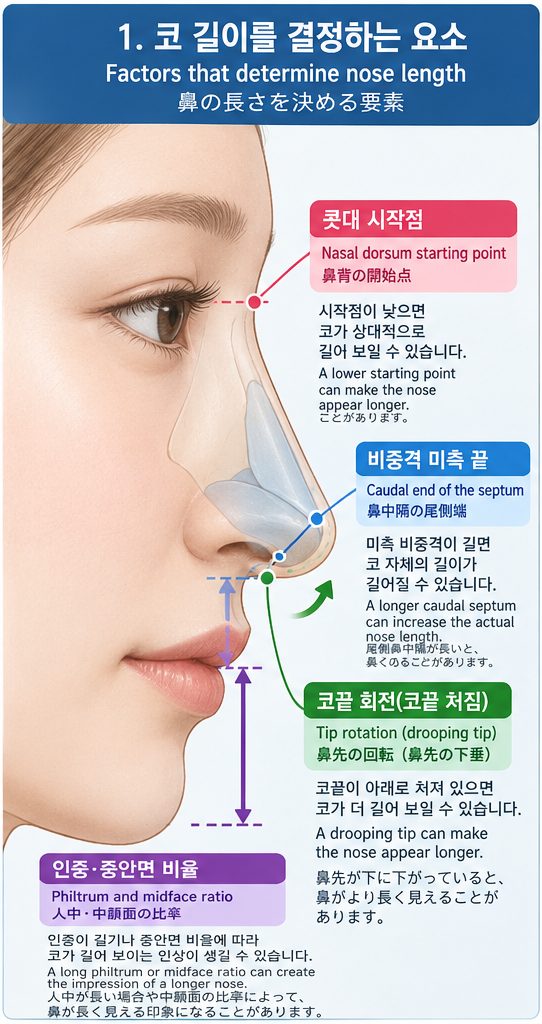
What are the different reasons a nose looks long?
The impression of length does not always match the underlying structure. A nose may seem long from the front while the true issue is a drooping tip, or the tip may sit at a normal position while a low starting point (the area between the eyes where the bridge begins) makes the nose seem longer.
| Cause | Typical examination findings | General approach |
|---|---|---|
| Drooping tip (insufficient rotation) | Small nasolabial angle; tip drops further on smiling | Tip rotation (adjusting the cartilage support) |
| Excess caudal septum | Nose is long front-to-back with a downward-pointing tip | Shorten the caudal septum, then reposition the tip |
| Low nasal starting point | Flat area between the eyes; nose looks relatively long | Build up the starting point to change the visual length |
| Lip / midface proportions | Nasal length itself is within a typical range | Assess factors beyond the nose; surgery may not be indicated |
What is checked at examination to decide on tip rotation?
In clinical practice, the following points are reviewed together to decide whether raising the tip is appropriate or something else is needed.
1. Nasolabial angle (the angle between the tip and the upper lip in profile). Commonly cited textbook reference ranges are roughly 95–105° for women and 90–95° for men, but these are general references and vary with overall facial balance and the individual.
2. Tip movement on smiling. If the tip drops noticeably, the influence of the depressor septi muscle is also assessed.
3. Columella and nostril shape from below. This helps predict whether raising the tip could expose the nostrils excessively.
4. Height of the nasal starting point. A low starting point can leave an impression of length even after the tip is raised.
5. Upper-lip length and maxillary support. If the upper lip is already long, raising the tip can make the nose–lip proportion look less natural.
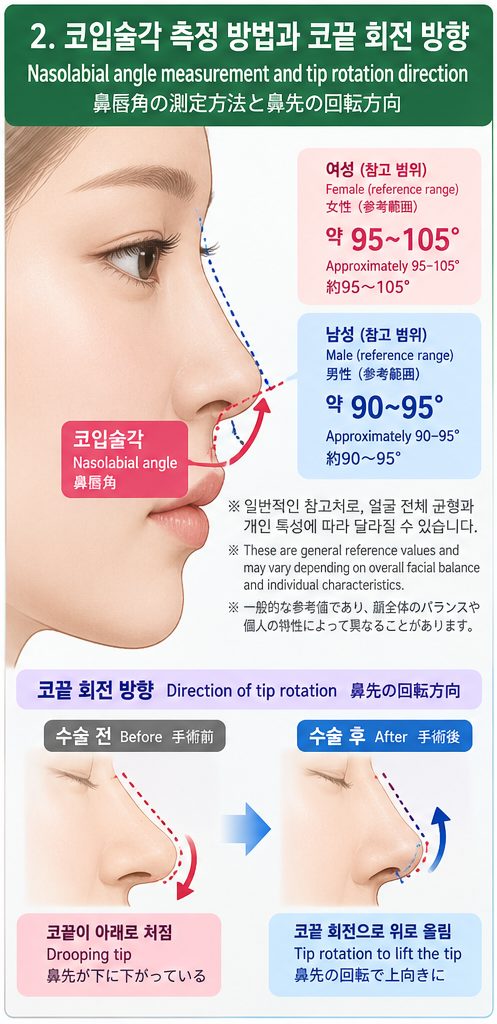
Tip rotation alone is generally not suitable when the caudal septum is genuinely long, when the upper lip is already long, or when earlier surgery has left the skin or cartilage thin or weakened. In these situations, over-rotating the tip can make the nose look short or the tip look upturned, so a cautious approach is needed.
Which materials are used to hold the tip, and when are they avoided?
Tip rotation is not simply pulling the tip upward; it is rebuilding the cartilage support so that the tip direction and position remain stable. The patient's own cartilage is usually considered first, and the choice generally follows these criteria.
- When septal cartilage is sufficient: septal cartilage is usually considered first as the support graft, although the amount that can be harvested is limited.
- When septal cartilage is insufficient or already used (e.g., revision surgery): ear cartilage or rib cartilage may be considered. For the differences between cartilage sources, see How Do Ear Cartilage and Septal Cartilage Differ in Rhinoplasty?; for situations in which rib cartilage is needed, see When Is Autologous Rib Cartilage Needed in Revision Rhinoplasty?
- Pulling the tip up with an implant alone: in patients with thin skin or in revision cases, the pressure on the skin and the risk of contracture are weighed carefully, and this approach is often not selected.
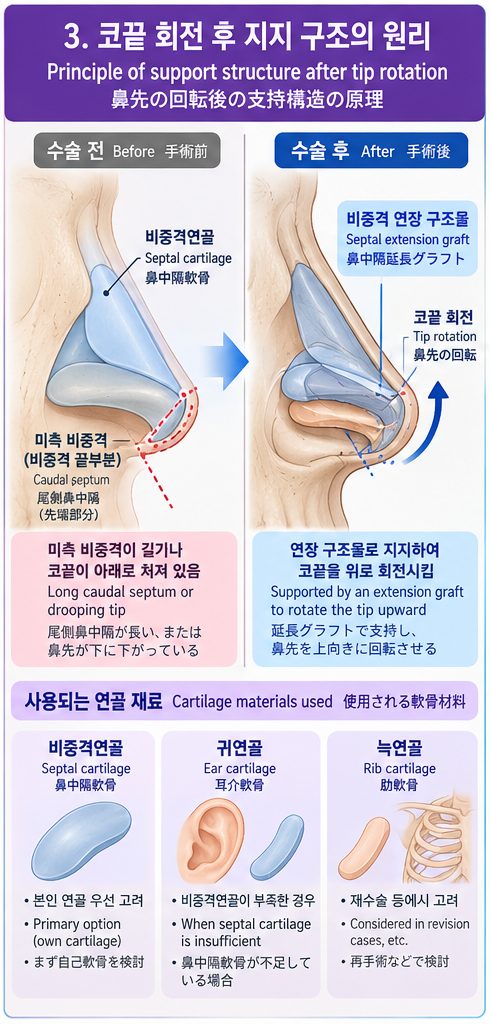
Excessive rotation can lead to an upturned-looking tip or, over time, to contracture. Whether an upturned tip is simply a shape change or is related to contracture is judged using the criteria in How Can You Tell a Simply Upturned Nose from a Contracted Nose?. If tip and alar proportions are also a concern, see Can a Bulbous Nose Be Corrected by Alar Reduction Alone?
When are additional tests needed?
Most evaluations rely on profile, frontal, and base-view photo analysis and a clinical examination. If nasal obstruction or septal deviation raises concern about breathing, or if prior surgery makes the internal structure uncertain, nasal endoscopy or CT may be considered. Situations in which testing is needed before revision surgery are summarized in When Is a CT Scan or Nasal Endoscopy Needed Before Revision Rhinoplasty?
Summary
- A nose looks long because of a combination of tip droop, caudal septal length, the nasal starting point, and lip or midface proportions.
- Tip rotation alone is enough in some cases, but others may need cartilage shortening or starting-point adjustment.
- Over-rotation can lead to an upturned or short-looking nose, or to contracture, so the degree must be chosen carefully.
- The suitable approach depends on each person's structure, skin, and cartilage, which is why an individual in-person assessment is needed.
Frequently Asked Questions (FAQ)
Q1. Will raising only the tip make the nose look short?
A. It depends on how much the tip is raised and on the original structure. Rotating beyond what is needed can make the nose look short or expose the nostrils excessively, so the appropriate degree is analyzed beforehand (varies by individual).
Q2. Can a tip that drops when smiling also be adjusted surgically?
A. The approach depends on whether the cause is structural or muscular. The smiling movement is observed during examination, and the same method is not used for every case.
Q3. Is my own cartilage always required?
A. A cartilage support is often used to hold the tip stably, and the patient's own cartilage is considered first. The amount and quality available differ between people and are assessed at examination.
Q4. Is tip rotation possible if I have had surgery before?
A. Earlier surgery may have changed the condition of the skin and cartilage, so feasibility and method need individual evaluation. Additional tests may be considered before deciding.
Sources
- Rohrich RJ, Adams WP Jr, Ahmad J, Gunter JP. *Dallas Rhinoplasty: Nasal Surgery by the Masters* (textbook), chapters on tip rotation and the caudal septum
- Daniel RK. *Mastering Rhinoplasty* (textbook), chapters on nasal profile analysis and tip rotation
- General patient-information materials from the Korean Society of Plastic and Reconstructive Surgeons
Note: These are general references; specific figures vary between studies and individuals.
Author: Dr. Jihun Kim, Board-Certified Plastic Surgeon, VVLY Plastic Surgery Clinic
Published: 2026-10-28 · Last updated: 2026-10-28
Disclaimer: This column provides general medical information and does not replace diagnosis or treatment for any individual patient. Indications, recovery, and possible complications vary between individuals, and an accurate assessment requires an in-person examination by a specialist.